ADR-0042: OpenAI-compatible model endpoints and an optional API key
- Status: Accepted
- Date: 2026-11-16
Context
Issue #834 extends the model boundary of ADR-0023 and the static credential rule of ADR-0037. Foundry already speaks Chat Completions and Responses, but binds them to an Entra identity. Operators also need the OpenAI API, gateways and models served inside a cluster. A protocol name is not a claim that every server enforces schemas. The decision of 2026-11-16 is one configurable provider, not one fixed vendor host. On 2026-11-17 the decision on issue #834 bound the models at install time as well: each endpoint declaration names an exact base URL and the model names allowed at it, so settings choose neither the base nor the model alias a gateway routes on.
Decision
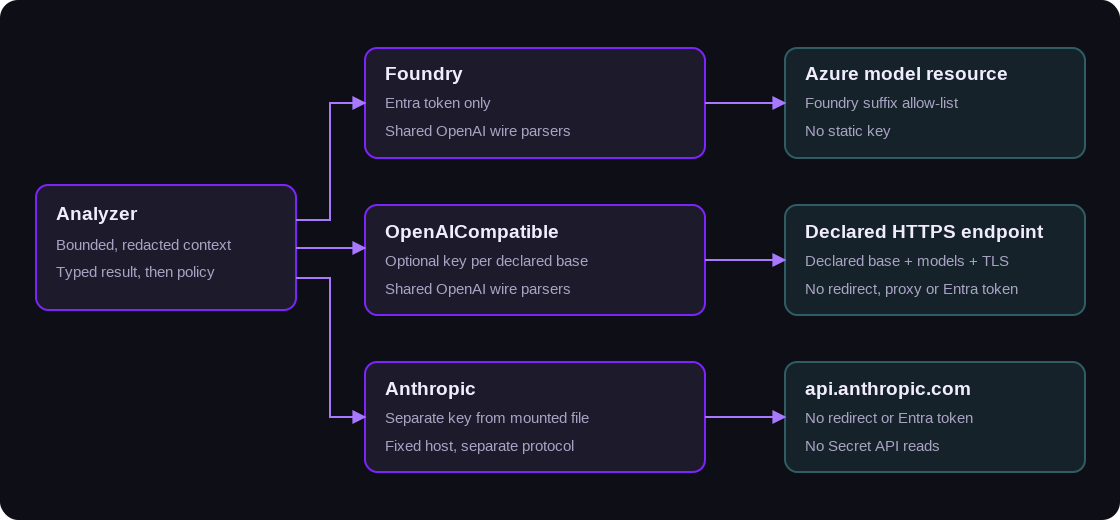
Three destination choices require install-time binding: the host, the gateway path and the model alias. A gateway can route an alias to another upstream, carrying the key and redacted context with it. Settings must choose no part of the request destination.
- The install declares each compatible endpoint through chart
analyzer.analysis.openAICompatible.endpointsor the analyzer's--openai-compatible-endpointsJSON array. Each declaration has an exacturl(scheme, DNS host, port and path prefix),inferenceAPI(ChatCompletionsorResponses), a nonemptymodelslist, optionallykeyFile, and optionallyservicewithnamespace, apodSelectorof 1 to 32 valid Kubernetes labels and pod targetport, refused otherwise by both chart render and analyzer startup. There is no compatible suffix list. Each model name matches^[A-Za-z0-9][A-Za-z0-9._-]{0,63}$. ChartapiKeysources are an existing Secret or CSI volume; the chart derives the declaration's mounted file path, one separate mount per endpoint. provider: OpenAICompatiblesettings nameendpoint,deployment(model name) andinferenceAPI(ChatCompletionswhen absent). The analyzer compares the parsed base and API against the declarations on every deployment. Scheme and DNS case, default port 443 and one trailing slash normalize; unreserved path encodings normalize after parsing. Dot segments, encoded separators, userinfo, query and fragment are refused, never cleaned into an allowed base. A mismatch endsEndpointNotAllowed. The deployment model must equal one of that endpoint's declared names byte for byte; otherwise it endsModelNotAllowedbefore any call. The request URL is the declared base plus the fixed/chat/completionsor/responsespath. Nothing from settings is joined into it.apiVersionis forbidden. CEL remains a shape check, never install authorization.- HTTPS with verified TLS 1.2 or newer is required, including for Services. There
is no proxy or redirect, including a same-host redirect. Public addresses are
checked at each dial. Only a declaration with
servicepermits private unicast addresses, and only for its exactservice.namespace.svcorservice.namespace.svc.cluster.localname. Loopback, metadata, link-local, multicast and reserved addresses remain refused. A Service address in 100.64.0.0/10 is refused too, even for a declared Service: carrier-grade NAT and cloud infrastructure share that range (one cloud serves its instance metadata at 100.100.100.200), so the dial guard cannot tell a Service there from a host outside the cluster. Such a cluster needs the inference Service on an RFC 1918 address. Each chart Service declaration adds one namespace/pod-selector egress rule on its target TCP port. Operators provision serving certificates, access controls and trusted roots. Declared HTTPS ports are bounded to 1 through 65535; the chart also opens each declared public endpoint port other than 443 in a separate egress rule excluding 10.0.0.0/8, 172.16.0.0/12, 192.168.0.0/16, 100.64.0.0/10 and 169.254.0.0/16. The existing 443/6443 rule is unchanged. Foundry stays on 443. Ranges the install declares as in-cluster (chart valueanalyzer.analysis.openAICompatible.inClusterCIDRs, flag--openai-compatible-in-cluster-cidrs, decided 2026-11-17) count like the private ranges: the dial guard of every compatible endpoint that is not a declared Service refuses an address in them, after DNS, for every resolved address and before any byte of the request or key is sent, and the IPv4 ones are added to the except list of the rule for declared ports other than 443 (that rule allows no IPv6 address). On 443 the dial guard alone enforces the private and declared ranges: that rule has no except list, since it carries the traffic to the API server at its in-cluster address. An entry must be a canonical CIDR without host bits, not a /0, and an IPv4 range in IPv4 form (no IPv6 range overlapping the IPv4-mapped, IPv4-compatible, NAT64 or 6to4 forms, which the guard already reads by their IPv4 address); the chart refuses any other entry at render and the analyzer at start (rule). - A key belongs only to its declaration's complete base. Two endpoints can have
different keys, including on the same gateway host at different paths. An
endpoint without a key sends no Authorization header. Only the analyzer mounts
the whole read-only Secret or CSI source, with no subPath, Secret API reads,
new RBAC, credential environment variable or custom resource field. Each attempt
rereads its bounded regular file, so rotation needs no restart. Unavailable or
empty files are retryable; malformed files, including keys shorter than 16 bytes,
are refused without retry and with a fixed message naming the minimum length.
Fixed errors and call reports never contain keys, paths, headers or response text.
A key file also belongs to one declaration (decided 2026-11-17): the analyzer
refuses at start two declarations that name one key file, and a declaration that
names the file of
--anthropic-api-key-file, by cleaned path and by file identity (os.SameFile, so a symbolic or hard link to the same file counts), and the error names the two declarations, never a path or content. A file that does not exist at start is compared by path only; before each read the compatible adapter and the Anthropic adapter check the identity of the handle they read against the other declared key files, so a file that appears later as a link to another declaration's key is refused without a request. The chart refuses at render what it can see: two endpoints, or an endpoint and the Anthropic key, that mount the same Secret key, taken through a secret volume'sitemswhen it has them (items that do not map the file name are refused). A projected or CSI volume cannot be resolved at render: only the same source written twice is refused, and keeping one key to one declaration there is the operator's to do. Two separate copies of one key in different Secrets are different files and are not detected. - Both chart render and analyzer startup refuse a declaration whose host matches
the Foundry suffix list, an Azure model host or
api.anthropic.com; duplicate parsed bases (even with different APIs or keys); a base that is a segment path prefix of another on the same scheme, host and port; missing, empty or invalid model lists; and malformed URL declarations. A generated corpus varies settings hosts, ports, paths, case, encodings and dot segments and asserts that credentials reach only requests under their own base. - The Foundry suffix list remains Foundry-only and never authorizes compatible
endpoints. Foundry refuses any declared compatible host, as does Anthropic's
fixed-host boundary. No Entra token or Anthropic key reaches the compatible
adapter (the key file rule of decision 4 covers the Anthropic key file) and no
compatible key reaches another provider.
--disable-foundryprevents inference token-source creation. Compatible-only installs need no Azure client ID for inference; Blob records still require Azure identity. -
Usage is untrusted. Let
Ibe the loop's conservative input estimate (one token per two bytes of messages, tool schemas, response schema and provider blocks),Othe request's output bound, andC = I + O + ceil((I + O) / 10)the ceiling. The 10% margin allows tokenizer variation without accepting an unbounded report. For complete, nonnegative reported usageR = input + outputat or belowC, chargemax(I, R), including a zero-token report and malformed output carrying usable usage. Cached input is part of input, never added twice. A report aboveCis refused as malformed output, its usage discarded (UsageUnknown), and chargedC. Missing, negative, incomplete or otherwise unusable usage is also refused withUsageUnknownand chargedC. Other failed sent calls, including throttling, costC; compatible hosts never mark a refusal unbilled. A call whose every attempt sent nothing costs zero. Every attempt is charged, not only the last (decided 2026-11-17): the adapter reports each attempt the endpoint may have billed, which is every attempt that got a response or failed after its request may have reached a connection, and not one that ended before: a key that could not be read, a dial the guard refused, a name that did not resolve or a connection that was refused. The loop charges each one,Cfor an attempt with unknown usage andmax(I, R)for one that reported usageR. The loop passes the number of attempts its remaining analysis and daily budget covers atC, and the adapter makes no further attempt beyond it, so one call cannot take spend pastmaxTokensPerDay. Foundry and Anthropic accounting is unchanged. Persistent daily token reservation across analyses remains #208. -
Responses and tool calls remain untrusted. Strict response schemas are requested, and the same typed result and tool argument validators refuse invalid answers. Existing Foundry tool strictness is preserved byte for byte. A server that ignores tools or schemas is not repaired or retried with weaker schemas: it fails the same validation and bounded hand-off rules. Operators must qualify each model, server, API and prompt combination with the evaluation harness, including forced escalation. A transport smoke result is not a passing scenario evaluation.
The credential echo check searches an allow-list view of the reply for the key before any completion is returned. The view keeps only ASCII letters, digits and the punctuation characters the key itself contains, and drops every other character, of any Unicode category, assigned or not. A character inserted between the key's characters (a zero-width space, U+034F, a variation selector, a Hangul filler or a visible letter of another script) is dropped by construction, so the check does not depend on a list of characters a screen does not show. The view is built over every decoded string value of the reply in document order as one stream, so a key split across fields, parts or tool-call arguments is found too; a second stream adds the object keys in their place, each of the two is also built with the numbers of the document in their place (a key split into a number), so a number never interrupts a stream of strings, and the fields the completion parser reads (text parts, content, arguments) are joined once more on their own. JSON text inside a string, such as tool-call arguments and structured content, is decoded up to three levels and takes the string's place in the streams; its text as written is searched as well. The raw bytes are searched the same way, and a reply that is not JSON is scanned only as raw bytes.
The check does not model terminal escape sequences. Model text is stored without
control characters: every code point of Unicode category Cc (C0, DEL, C1) except
newline and tab is removed where model output enters the analysis loop, for every
provider (#852). What is
stored is then what any terminal shows, and the view drops a superset of what
storage removes, so a key that is contiguous in stored text is contiguous in the
view and is refused. A sequence with visible parameters inside the key, such as
ESC [0m, is not refused: storage removes the ESC, and the stored text shows
[0m between the key's characters, so no reader sees the key whole. A grammar
of terminal behaviour in the scan was tried and dropped: it is a list of what a
screen hides again, and it diverged from what a reader sees field by field. This
provider needed #852, which is built (amendment of 2026-11-22). Every pass is linear in the size of the
reply; the tests bound the work at a fixed multiple of it.
The key must be printable ASCII and at least 16 bytes; anything else is refused as malformed when the key file is read, before any call, so the view never searches for a key it cannot hold or one too short to search. The check fails closed: the scan of every value runs whatever the typed decode of content and arguments does, and a reply whose content or argument fields have a wrong JSON type is refused with its own fixed text, "the reply has a field of the wrong type", as malformed output like an echo (the completion parser refuses such a reply too).
The check has a stated limit. A key that comes back re-encoded (base64, percent encoding, homoglyphs, reordered characters) or split across two replies is not found, and no check of this kind can find it. The endpoint is given the key at install and is trusted with it: the check stops an echo from reaching status, Events, logs and pull requests in a form a reader can use, and is not a defence against an endpoint that hides the key. The check covers terminal tricks only together with #852 (built): without it, control characters and escape sequences inserted into the key could hide letters from a raw terminal that the view keeps. Outputs remain untrusted: the redactor checks records and telemetry, typed result and tool argument validation and deterministic policy constrain proposals, and credentials never authorize a remediation. Operators must trust the endpoint with its dedicated, spend-limited credential.
Consequences
This extends ADR-0037. Anthropic keeps its fixed host and separate key; Foundry keeps its suffix boundary. Invariants 1 through 5 retain their validation, authorization and Git boundaries. Invariant 6 covers only the analyzer's optional endpoint-bound compatible keys under every existing static credential condition. Executor and verifier receive no key or new privilege. A settings editor can select declared endpoints but cannot choose a different destination for any key. Use dedicated inference credentials and server-side spend caps. An endpoint operator can see redacted context. Check retention, residency and that training is opt-in before allowing a vendor; the Azure region promise does not cover this provider. A compromised analyzer can read its mounted credentials. Standard NetworkPolicy permits HTTPS addresses, not DNS host identities.
For this provider only, ADR-0042 amends decision 9 of
ADR-0023 (its amendment of
2026-11-17 links back here): every usage counts at least the loop's input
estimate, at most the ceiling C of decision 7; a reply that reports usage above
C is refused and charged C; and a 429 or other refusal of a compatible host
is never treated as unbilled, so a failed sent call costs C; and each attempt
of a retried call the endpoint may have billed is charged on its own. Foundry and
Anthropic accounting is unchanged.
An accepted limit: an endpoint that reports less usage than it billed is charged
the larger of the input floor I and its report, so it can undercount by up to
the output ceiling of each attempt. Server-side spend caps on the dedicated key
bound that.
Two trust assumptions remain:
- The pod and Service ranges of the cluster are known to the install. The dial
guard and the egress except list treat the private, shared (100.64.0.0/10) and
link-local ranges as in-cluster, plus the ranges declared in
inClusterCIDRs(decision 3). A cluster whose pods or Services use other routable addresses must declare them; an undeclared range is treated as public, and a declared public endpoint whose DNS points into it would get the key and the redacted context. The analyzer does not read the ranges from Nodes: see Alternatives. - The right to create pods in a declared Service's namespace, or to edit that
Service or its EndpointSlices, is equivalent to holding the key and the redacted
context. Such a pod can mount the namespace's Secrets, including the Service's
serving certificate, so verified TLS does not stop it; routing follows the
Service's own selector and EndpointSlices, not the declared
podSelector; and where the CNI appliesipBlockrules to pod addresses, the 443 rule admits any pod. Run the inference Service in a namespace where only cluster administrators create pods.
Adversarial analysis
| Attack | Control and remaining boundary |
|---|---|
| Settings points at an attacker host | Exact parsed install-time base, API and model matching; requests use declaration data only, including the fixed inference route |
| Redirect or proxy steals a key | No redirects of any status and no environment proxy |
| Public DNS rebinds into the cluster or metadata | Address checks on each connection, against the private ranges and the declared in-cluster ranges; private addresses only for explicitly named Service hosts, never metadata or loopback |
| Service impersonation | Verified TLS with the Service DNS name; cluster operators own certificates and Service routing. Pod creation in the Service's namespace, or edits of the Service or its EndpointSlices, bypass it (a pod can mount the serving certificate): only cluster administrators may create pods there |
| Error or output echoes the key | Fixed errors, bounded discarded error bodies, no wrapped transport or filesystem errors; before a completion is returned, search an allow-list view of the reply (ASCII letters, digits and the key's punctuation, every other character dropped) over the raw body and over every decoded string, number and object key in document order, with nested JSON decoded; control characters are removed from model text before storage (#852), so a key whole in stored text is whole in the view; a wrong-typed decoy field fails closed with its own fixed text. A re-encoded key (base64, percent encoding, homoglyphs) is not found: the endpoint is trusted with the key |
| Server ignores schema or invents a tool | Shared parser, typed argument/result validation, closed catalog and deterministic policy; no output repair |
| Server omits usage or returns 429 | Unknown usage costs the upper bound; no compatible-host unbilled exception |
| Gateway fails each reply after the headers to multiply billed retries | Every attempt that may have been billed is charged, at C when its usage is unknown; no retry the remaining budget cannot cover at C |
| A declaration names another provider's or endpoint's key file | Refused at start by path and file identity, and before each read by identity in both adapters; the chart refuses a shared Secret key, through items too (not a projected or CSI volume) |
| Key rotation races a call | Read per attempt, bounded retry, no cached key; update source before revoking old key |
What is not built
Plain HTTP, arbitrary private-network gateways, custom authentication headers, provider fallback, credential discovery, Azure tokens on compatible endpoints and new permissions and chart-managed custom CA mounts are excluded. Cluster Service certificates need a trusted root, provisioned in an operator-built analyzer image when using an internal CA. The runtime qualification gate and persistent daily token counter remain planned. Qualify each model and server with the evaluation harness and test the key mount in an isolated Kind install with a dummy key. Offline transport tests do not replace scenario qualification.
Alternatives considered
- A host suffix list with a key bound to a host leaves settings in control of the path. On a shared gateway that path can select another tenant or upstream. This alternative was not chosen: restricting hosts does not bind credentials to an account or model upstream. Exact install-time bases and model lists remove those destination choices from settings.
- An egress proxy or FQDN egress policy for declared hosts adds an infrastructure dependency and does not bind gateway paths or model aliases. Operators may add this defense in depth; portable NetworkPolicy and application checks remain the shipped boundary.
- A separate credential-holding egress component (a sidecar or small proxy with its own identity) that owns the key and forwards only to declared bases. The analyzer would never read the key. Not chosen now: it adds a component and an identity. It is the next step if a compromised analyzer reading its mounted keys becomes the concern.
- Reading the in-cluster ranges from the cluster (
spec.podCIDRsof the Nodes, and the Service range) instead of declaring them. Not chosen: the analyzer'sliston Nodes is granted for platform detection only (invariant 6), and using it to decide where a key may go widens what that grant is for; the Service range would need a further grant (theServiceCIDRobjects, where the cluster serves them); and a range read at run time changes with the cluster while the declaration is fixed at install and checked at start. The install declares the ranges instead, with no RBAC change. - A fixed-host OpenAI provider excludes gateways and cluster servers.
- Reusing Foundry with a key mixes identity and Azure URL/version semantics.
- Refusing all private addresses excludes cluster inference; explicit Service declarations provide a bounded TLS and egress exception without new RBAC.