The analyzer as a harness
The analyzer calls a model, but the model is the smallest part of what makes it safe. Around it is a harness: code and rules that decide what the model is told, what it sees, what it can touch and how its work is checked. The model reasons. Nothing it says is authorization: its only output is a proposal, and a deterministic policy check outside the model decides whether it goes any further (invariant 1).
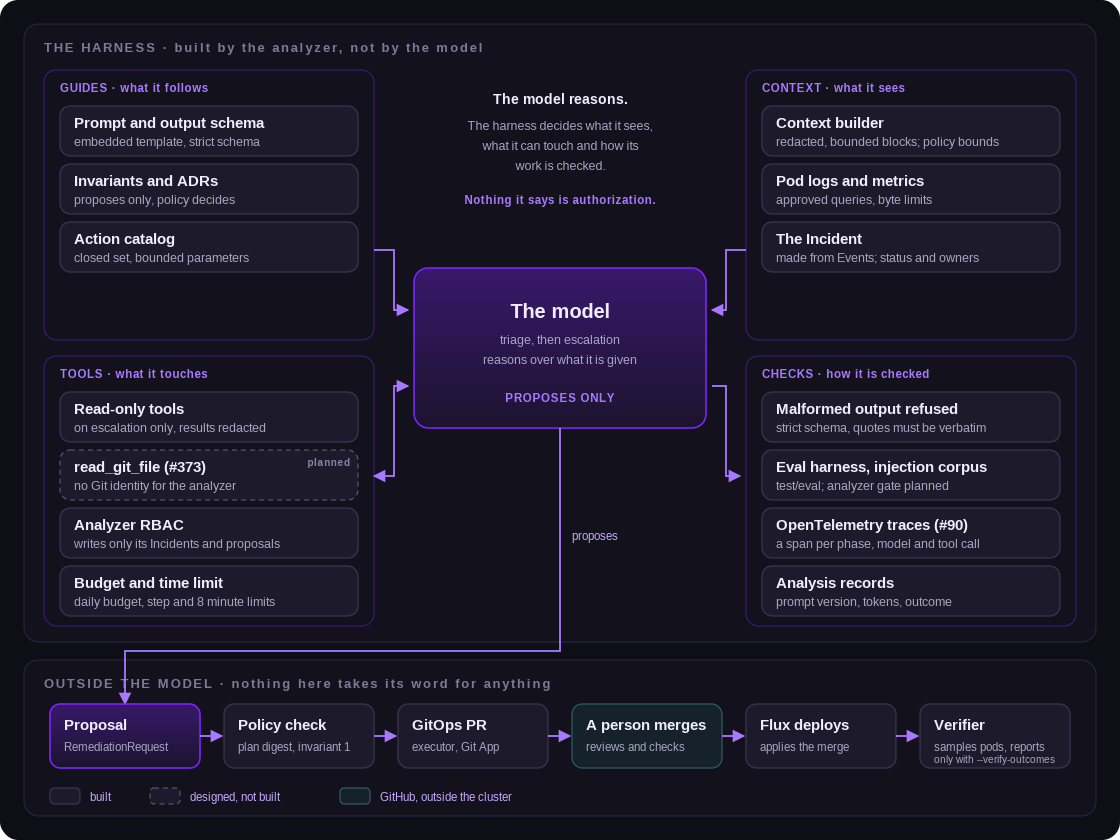
Dashed boxes are designed, not built. The teal box is GitHub, outside the cluster; Flux runs in the cluster. For a reader-level view of the model and its harness, see Working with models.
Where each box is described
| Box | Status | Design section or code |
|---|---|---|
| Prompt and output schema | built | 3.3, the prompt and the result; internal/analysis/prompts |
| Invariants and ADRs | built | 10. Security, ADR-0003, ADR-0023 |
| Action catalog | built | 10.4, bounded actions; policy.CheckAction |
| Context builder | built | 3.3, the context builder; internal/incidentcontext, internal/redact |
| Pod logs, metrics, the Incident (made from Events) | built | 3.1, 4.1, 4.2 |
| Read-only tools | built | 4. Tools; internal/tools |
read_git_file |
planned | 4. Tools, #373 |
| Analyzer RBAC | built | 10.1, 10.11 |
| Budget and time limit | built | 3.2, the analysis budget, the loop and its limits |
| Malformed output refused | built | 3.3, the prompt and the result; internal/analysis/result.go |
| Eval harness and injection corpus | built, the analyzer's own gate planned | 11.2, evaluation gate, evaluation; test/eval |
| OpenTelemetry traces | built, off by default | Traces reference |
| Analysis records | built, with a record store | ADR-0015; internal/analysis/record.go |
| Scoring of records outside the cluster | built as a command that scores one record file; the job and its trigger planned | ADR-0047, scoring intake; cmd/intake, internal/intake |
| Proposal, policy check, GitOps PR | built, up to Merged, then WaitingForDelivery and Verifying ending Failed or Inconclusive behind --verify-outcomes (off by default) |
6. Reconciliation, 8. GitOps on GitHub |
| Person merges (GitHub), Flux deploys (in the cluster) | not part of Shadewright | 8. GitOps on GitHub |
| Step log and replay by step | planned | Working with models |
| One bounded extra round when the answer names missing data a tool can fetch | planned | Working with models |
| Verifier | built, writes reports only with --verify-outcomes on (off by default); the executor reads them as untrusted evidence and decides Cleared (built, #683) |
10.9, verification |