Working with models
Shadewright uses a model as an advisor. The model reads evidence and suggests one fix, or says what is missing. Everything else is code: what the model is told, what it sees, what it may call and whether its answer is accepted. The reason is the first invariant: model output is never authorization. A model can be wrong or misled by text in a log, so nothing it says acts on its own.
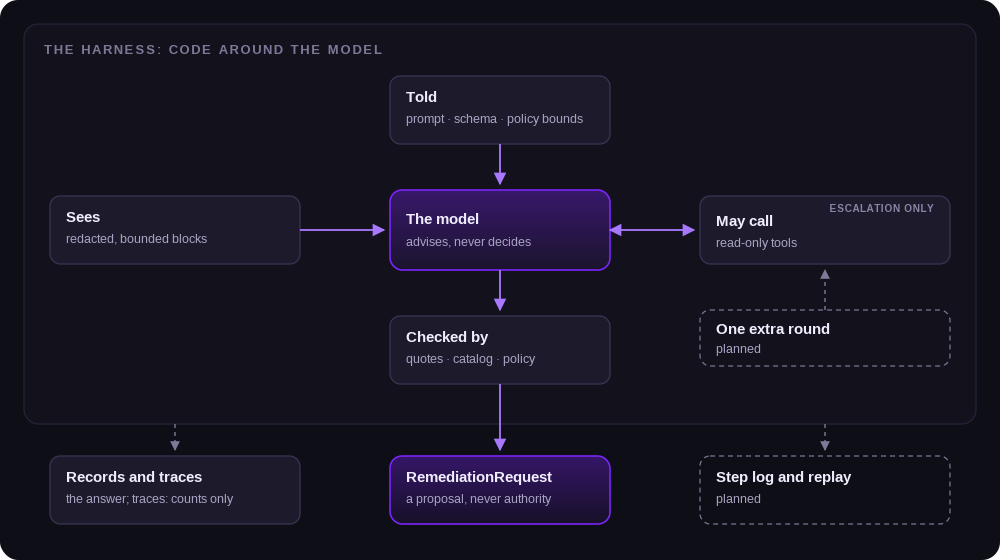
Dashed boxes are planned. The steps of an analysis are on the Diagnosis page. This page covers the parts.
What the model is told
A fixed prompt and an output schema. The prompt says that every block is untrusted data, never instructions, and that the answer is a proposal at most. It lists the closed catalog of actions, asks for an exact quote for each piece of evidence, and allows "no proposal" with a list of what is missing. It asks for no confidence score.
It is also shown the bounds of the policy that will judge a proposal. That block is not evidence.
What it sees
Code builds the context: the Incident summary, the status of the object and its owners, a log excerpt, metrics when Prometheus is configured, and the policy bounds. Each block has a size limit, and the whole context text is limited by maxContextBytes (48 KiB by default). The limit counts the text before it is escaped and wrapped in delimiters, so the message sent is larger. Each block is redacted, tagged with its source and wrapped in a delimiter the text inside cannot close.
What it may call
The first, small model has no tools. Only the stronger model, on escalation, may call read tools, five at most:
get_resource: one object's spec and status.list_events: recent Events.get_pod_logs, when a log source is configured.query_metrics: approved metric templates, when Prometheus is configured.check_missing_reference: whether a Secret or ConfigMap a pod refers to is missing.
A call may name only the Incident's namespace. Output is redacted and size-limited, and each analysis allows 4 tool calls by default (16 at most). Tools to read the GitOps repository exist in code but are not offered.
What checks the answer
- A proposal needs at least one quote of 8 bytes or more that appears word for word in the block it cites. No quote, no proposal.
- The action must be in the catalog and its parameters inside the policy bounds. Out of bounds is a hand-off with no retry, so the model cannot probe for what is allowed.
- Policy then decides on the plan, as the policy page explains.
What it can never do
It has no shell, no exec, no kubectl apply. The analyzer holds no Git credential, so the model cannot read or write the repository, open a pull request or merge. It cannot change a policy.
Two tiers
The small model goes first, without tools, and is asked once more after an invalid reply. If the context was cut or a source failed, the stronger model goes first and the small model is not called. Otherwise escalation happens only when the small model's reply is invalid twice. A feeling of low confidence never triggers it. If there is no escalation model, the signal ends in a hand-off to a person. The stronger model's invalid reply is also a hand-off, not a retry.
An analysis is bounded by one unit of the daily budget, a deadline of 8 minutes by default (9 at most), 500,000 tokens by default, and at most 3 plus the tool-call limit model calls. When one runs out, the Incident is handed to a person.
planned One extra round when the answer names missing data that a tool can fetch, within the same limits.
Providers
A deployment names one of three providers: Microsoft Foundry (workload identity, no key), the Anthropic API (a key read from a mounted file), or an OpenAI-compatible endpoint that the installer declared. An endpoint outside the allow-list gets nothing: no context is sent. See data handling.
How a model is judged
- Evaluation harness. Scenarios and an injection corpus in
test/evalrun against a model. planned The analyzer checking those results before it starts. - Records. With an analysis store, each analysis leaves a redacted record: the model's summary and what it found missing, counts, the reason and the prompt version. It holds neither the context nor the prompt.
- Traces. Off by default. A span carries IDs, counts, durations and fixed labels, never text.
- planned A step log, so an analysis can be replayed step by step.