6. Reconciliation
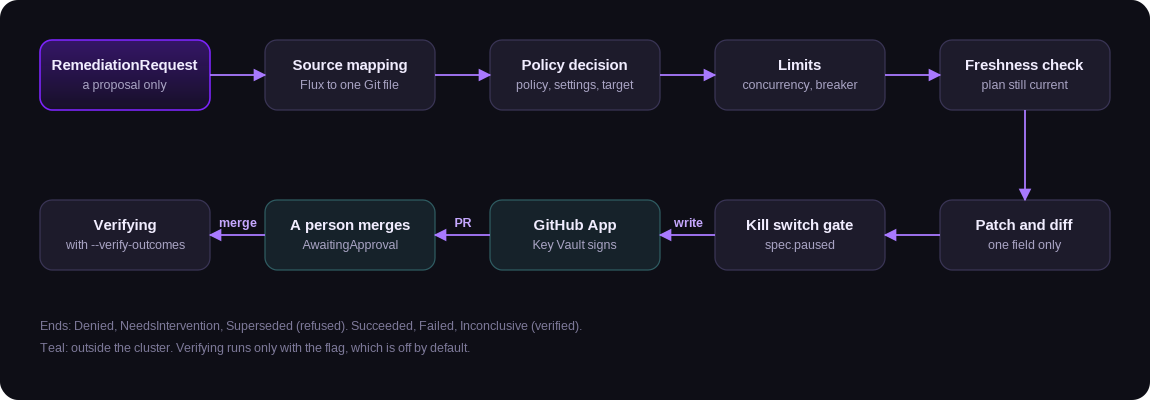
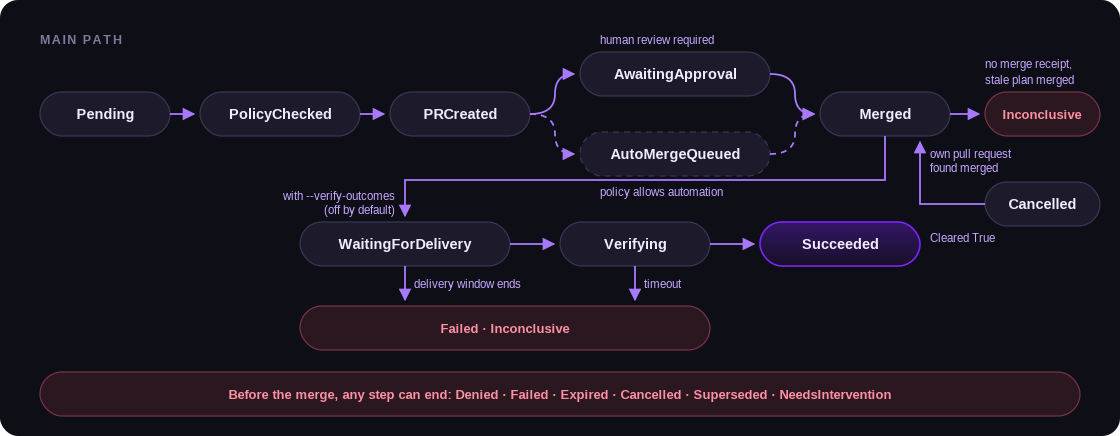
This section covers how a RemediationRequest moves through its phases: the phases and transitions (6.1), the policy check that decides a request (6.2), retries and deadlines (6.3), the shape of every reconcile (6.4), the pull request step (6.5), the checks that run before every write (6.6) and what happens when a request is deleted (6.7). Numbers and edge cases that only matter when you build or debug are in the table "Details" at the end (6.8).
The steps after Merged are built (#678, #681, #683): the merge receipt, the delivery window, the executor's own checks after the delivery, and Cleared judged from the verifier's report (#682), ending Succeeded, Failed or Inconclusive. They run only with the executor flag --verify-outcomes (chart value executor.verification.enabled), off by default until a lab run with a release candidate decides the default. On with the verifier deployed, a request can end Succeeded; on without a verifier, no report is written and every merge ends Inconclusive (StaleReport) or Failed, so the circuit breaker would not close again once tripped. Off, a merged request keeps Merged with its rollout report (#532), except a plan merged after it was known stale: it ends Inconclusive (StalePlanMerged) once its rollout check is over, and the circuit breaker never reads it as a success (6.5).
Other terminal or waiting phases: Denied, Failed, Expired, Cancelled, Superseded, NeedsIntervention, Inconclusive (merged, and neither success nor failure could be shown, ADR-0030 section 5). Conditions explain why; phase is a summary for humans.
6.1. Phases and transitions
The API defines every phase below. The executor sets the first step: a Pending request (or one without a phase yet) becomes PolicyChecked, Denied or NeedsIntervention in one status write.
What happens next, step by step:
- Held back by a limit. A request the policy allows stays
Pendingwith the conditionQueuedwhile a limit of section 10.7 holds it back. It is checked again every 30 seconds, or every 10 minutes (and when the holder changes) behind a lock held by a request that stopped. - A duplicate of a merged request. An undecided request whose Incident and target already have a merged request ends
Superseded(AnotherRequestMerged) before it takes the target lock (6.6.3). - After a pull request closed without a merge. An undecided request that waited behind the target lock of another request for the same target and field, whose pull request was then closed without a merge, ends
Superseded(AnotherRequestClosed) before it takes the lock (6.6.4). - After the change it waited behind succeeded. With
--verify-outcomeson, a merged request keeps the target lock until it ends. An undecided request that waited behind it, for the same field, from the same previous value and in the same direction, endsSuperseded(AnotherRequestSucceeded) when it endsSucceeded, and is decided as usual when it endsFailedorInconclusive(6.6.5, #719). - Freshness before merge. The executor re-checks the freshness of a decided request before merge every five minutes, and at once on any change to the request (once its pull request waits for review, only when no full recheck ran in the last five minutes). While a pull request waits for review, the executor only looks at the pull request in between, every
--pull-request-poll-interval(one minute by default), so a merge or a close is seen within that interval (#434), and the full recheck also says when the Incident stops while it waits (step 4, #715); a look writes nothing to Git, so every write still comes right after a freshness check. A stale plan becomesSuperseded, orNeedsInterventionif its repository settings became unusable, without waiting for a write. - Opening the pull request. A fresh
PolicyCheckedrequest opens its pull request and moves toPRCreatedandAwaitingApproval(6.5). One whose Incident was folded into its cause's Incident, or is gone, by the last step before the open endsCancelled(IncidentFolded,IncidentGone) instead (#794). - Merge. Observing a person's merge is built: the request then reaches
Merged, with the merge receipt in the same status write; a merge without a full merge commit ID endsInconclusive(NoMergeReceipt) on the next reconcile (step 5 of 6.5). - Delivery and verification. Built (#681, ADR-0030 sections 2 and 4), behind
--verify-outcomes(off by default; off, a request found inWaitingForDeliveryorVerifyingendsInconclusivewithVerificationDisabledat its next reconcile, so none stays there). AMergedrequest with a merge receipt moves toWaitingForDeliveryon the next reconcile, withstatus.deadlineat the end of the delivery window: one hour aftermergeReceipt.mergedAt, extended by the time writes were paused. Delivery is asked against the receipt (its merge commit on its target branch, and the ancestry of a later applied commit in the receipt's repository), never the live settings. When Flux reports the merge commit, or a later commit that holds it, applied, one status write recordsappliedObservedAtand the rollout fields, setsDeliveredTrueand moves the request toVerifyingwithstatus.deadlineat the timeout: the larger ofspec.verification.timeoutand the rollout deadline plus the effectivestableForplus--node-grace, 21 minutes for a memory fix with the defaults. At the end of the window without that, the last read decides: Flux failing on exactly the merge commit endsFailed(DeliveryFailed); a failure on a later commit that holds itInconclusive(DeliveryBlocked); a suspended KustomizationDeliverySuspended; anything elseDeliveryNotObserved; reads that fail to the end of the window plus 10 minutesDeliveryNotChecked, a Flux that keeps moving between applied commits while it is read included. A cause that does not clear by itself (the receipt's repository gone from the settings or unusable, a Git provider without an ancestry check, no delivery verifier) is retried too, and named inDeliveredand the final message. A failure inside the window is not final, since Flux retries. Every reconcile inVerifying(every 30 seconds) reads the target again: a live field without the desired value endsInconclusive(ConfiguredFalse,ValueChanged), a pod template or revision other than the one recorded endsRolloutSuperseded, andRolledOutfollows the rollout (RolloutPartitionedfor a partitioned StatefulSet, naming the pods left on the old revision). A target that is gone endsTargetGoneand one with another UIDTargetReplaced, at once, in either phase. A field that cannot be read on the target endsInconclusive(TargetNotChecked), notValueChanged. Each check then judgesCleared(#683, ADR-0030 sections 4 and 7): it reads the verifier'sVerificationReportof the request (get, operator namespace) as untrusted evidence. An OOM kill of the action's container recorded in a report bound to the request endsFailed(OOMKilled) at once. A check is good whenRolledOutisTrue, every desired replica is available (elseNotAvailable) and the report passes the trust contract: missing, never sampled or with a sample counter that has not risen for 90 seconds by the executor's clock isStaleReport, another request, merge commit, target UID, template revision or container isReportMismatch, coverage short ofspec.replicasisPartialRollout. A good check opens the executor's own window (status.verification:windowStart,lastReset,resets, forward only by CEL), a bad one resets it. The request endsSucceeded, withClearedandVerifiedTrue(NoRecurrence;ClearedgetsResolvedBeforeRolloutinstead under the rule below) in the same status write, when a good check finds both spans at least the effectivestableForplus--node-grace(the report's on the verifier's clock, the executor's on its own) and the report's counter higher than at a check at most 30 seconds earlier; once both spans are long enough the executor checks every 15 seconds. The counter is kept in memory. A check whose status write fails keeps the reset it found in memory, and the next check applies it again to the window it reads, so a lost write cannot let a window span the bad check it missed and end a request, a revert or a ScaledObject included. A restart or a leader change loses that memory, so no window counts time from before the executor process began reconciling (taken once on its clock, when it wins leader election, which on a standby that becomes leader later is that moment, not its start): the first check of the new process resets every open window that no check of its own opened, a revert's and a ScaledObject's included, withExecutorRestarted(time: the second before that moment, or the storedwindowStartwhen that is later), and stores the reset like any other (#895); which window is its own the process keeps in memory, so nowindowStartan earlier leader wrote on its clock is compared with this one's, and a skew between them either way cannot keep an old window open, sostatus.verificationshows the restart and the stored window is the one that decides; the same check opens the window again when it is good. The process remembers the start of every window its own checks opened for the request, whatever became of the status write that carried it (lost, stored, or stored with an error returned), up to 16, the oldest forgotten first; any of them in status counts as its own, so status writes lost in any order are never taken for a restart (#970, ADR-0030 amendment of 2026-11-21). Past 16 windows a check that reads a forgotten one records a restart, which only makes the request wait longer. The cost: after a restart or a leader change every open window needs a fullstableFor(plus--node-gracefor a pod target) again, so a request whose timeout comes sooner ends at the timeoutInconclusivewith the newest reset of its windows (ExecutorRestartedwhen it is the executor's last reset and the report counted no reset since the check that recorded the restart, by the report's ownresetsas that check read it; the usual order when an earlier process recorded it), neverSucceededand neverFailedfor it; an executor that keeps restarting ends no verification before its timeout, the fail-closed side. A ScaledObject cannot succeed: once ready and configured forstableForit endsInconclusive(ClearingNotChecked), and a request namingQueueBacklogDecreasingendsInconclusive(CheckNotAvailable) where it would succeed. At the timeout a request endsFailed(RolloutStuck) whenRolledOutisFalse,Failed(KedaNotReady) when a ScaledObject target is not ready by the KedaReady rule,Failed(Restarted) when a report bound to the request recorded a restart above its baseline after its window opened, and otherwiseInconclusivewith the reason that holds the window closed (for exampleStaleReport, orPodNotReadyfrom the report for a pod not Ready without a restart). A report that cannot be read is retried, never read as missing, until 10 minutes past the timeout. A target that cannot be read until 10 minutes past the timeout endsRolloutStuckwhen that was recorded, elseInconclusive(TargetNotChecked). Each wait is measured on the executor's clock from a time it recorded itself; a clock set back by more than a minute ends the waitInconclusiveat once instead of stretching it, and one up to a minute behind (a leader on another node) does not. A request whose applied time the rollout report recorded inMerged, past its timeout when--verify-outcomesis turned on, endsInconclusive(ClearingNotChecked). The circuit breaker readsWaitingForDeliveryandVerifyingas neither a success nor a failure (10.7), and with the flag on also aMergedrequest with a merge receipt, which has not moved toWaitingForDeliveryyet: read as a success in that gap, a half-open probe that has just merged would close the breaker before its outcome is known. With the flag offMergedis a success, as before #681; aMergedrequest without a receipt is read as before (likeInconclusivewith theNoMergeReceiptmark, a success otherwise). The kill switch gates writes only: while writes are paused every read still runs, and only the delivery window is extended. Past the merge a deadline never ends a requestExpired. - Rollout after the merge with
--verify-outcomesoff, or of a request without a receipt. Built (#532), reporting only, for every merged request while--verify-outcomesis off, and for a request merged before receipts existed (MergedBeforeVerification): the phase staysMerged, except for a plan merged after it was known stale, which endsInconclusive(StalePlanMerged) once the check below is over, good or bad (#199). The executor waits up to an hour after the merge for the Flux Kustomization that applies a Deployment or StatefulSet target to report the merge commit (or a later commit of the target branch that holds it) applied, records that time once instatus.pullRequest.appliedObservedAt, then reads the target's rollout status and setsRolledOut:Truewhen every pod runs the applied template,Falsewith reasonRolloutStuckand one core Event when it did not within 10 minutes of that time. A delivery not seen within the hour givesFalsewith reasonDeliveryNotObservedand one Event; a target of another kind givesUnknownwith reasonKindNotChecked. The target branch asked about is the one in the merge receipt when there is one, which for a pull request moved to the target branch the settings name after a change and merged there is that branch (#771), andstatus.source.targetBranchotherwise; theDeliveryNotObservedmessage names it. The ancestry of a later applied commit is asked of the receipt's repository, opened by its URL and installation whatever target branch the settings name now, so a later commit of the receipt's branch counts after a retarget too; only a request merged before receipts existed asks the plan's repository through the live settings. One function (mergeQuery) makes that choice for both modes, and while writes are paused this check asks the Git host nothing and waits. It never acts on a pod (invariant 2) and uses only thegetit already holds (invariant 6). A read that fails or a cancelled reconcile is never a verdict, but the check always ends with one: a stuck rollout is read again for an hour after the deadline, a newer template revision ends it withRolloutSuperseded, a gone or unreadable target withRolloutNotDetermined. The delivery is checked before the hour is judged, and time while writes are paused does not count against the hour (status.rollout.pausedSinceandpausedSeconds), so a resume leaves the unused part of it. The rollout judged is the one the applied commit produced: right after Flux reports it applied, the executor reads the target and records, in the same status write as the applied time, the commit Flux applied (status.rollout.appliedRevision), the target's generation and a hash of its pod template, after asking Flux once more that it still reports the same commit applied (otherwise it looks again); the template revision is recorded once the target's controller observed that generation and the target's current one (a Deployment's revision annotation can name a later generation before its status does), and a template that changed again before then ends the check withRolloutSuperseded. A later commit of the target branch that holds the merge commit counts as ours, so the template it produced is judged. A change made outside Git (kubectl edit, another controller) that lands before that read cannot be told apart and is not covered.status.rolloutis set once: CEL rules keep it and each of its fields, andendednever goes back to false, so neither the delivery window nor a final verdict can be reopened by a status write. - Resolved before the rollout. Built (#684, ADR-0030 section 4). The executor reads the request's Incident with its existing
getand records itsstatus.counttwice instatus.verification.incidentCount, each reading{uid, count, readAt}withreadAton its own clock, never changed once set but removable (CEL; an executor rolled back to a release without the field drops it, and a removed reading is never taken again):atMergeonly in the status write that setsMergedwith the receipt (when that read fails it stays absent for good, since a later reading could follow the change), andatAppliedin the status write that setsappliedObservedAt, never later, and only by the process that tookatMerge(after a restart or a change of leader in between the reason staysNoRecurrence). The read is skipped when the step's deadline leaves less than its own timeout plus one minute, so it never shortens the status write.atMergetakes its time after the read andatAppliedbefore it, so the recorded span never exceeds the real one.ClearedTruecarriesResolvedBeforeRolloutinstead ofNoRecurrenceonly when both readings exist, both UIDs equalspec.incidentRef.uid, the counts are equal and below 1000000 (saturated), andatApplied.readAt - atMerge.readAtis at least the effectivestableForplus twice the analyzer's aggregation window (aggregation.DefaultWindow, 5 minutes). A failed read never delays the merge, the delivery or the phase: the reading stays absent and the reason staysNoRecurrence.Verified, the phase and the circuit breaker do not change, and nothing branches on the reason. - A revert. Built (#96, ADR-0030 section 8): a request with
spec.revertshas its link checked before the policy check (the named request exists with that UID, endedFailedwithVerifiedFalse, is not a revert itself, has the same Incident, target, action type and container, its previous and desired are swapped exactly, and the revert's name derives from the failed UID), else it endsDeniedwithInvalidRevert; a failed read of the named request is retried. A valid revert goes through the policy check and the pull request like any request, always with approval required, except that its pull request's title, body and rollback line differ (see step 3). InVerifyingit reads no report: once rolled out, configured and available (at least one desired replica) held forstableForit endsInconclusivewithRevertApplied, neverSucceeded, withClearedUnknown(RevertApplied); a check before the rollout completed resets its window (PartialRollout). The circuit breaker never reads a revert as a success, in any phase. The analyzer's deterministic revert proposer (internal/analyzer/revert, no model call) creates the revert of a request that endedFailedwithVerifiedFalse: the same Incident, target and policy, the inverse action (InverseAction, the helper the link check compares against), approval required, named after the failed UID; it records its decision in the Incident'sstatus.revertsProposedbefore the create (Pending, thenCreatedonce the revert exists) and never takes a second one, also after the revert was deleted. The two exceptions are ADR-0030's known limits: the move toCreatedwas lost and the revert was deleted before the retry, or two analyzers run without leader election. For aPendingentry it reads the revert's name first: a revert there that names the failed request moves the entry toCreatedwhatever the checks say now. Otherwise every create, the first or a retried one, runs the same checks first, and right before it the Incident is read again (no create when the entry is no longerPendingor the Incident is being deleted); when a check says no, the revert's name is taken by a request with another link, the create is refused as invalid, or the failed request is deleted or its name taken by another UID, the entry moves toAbandoned, final, with areasonand one Warning eventRevertAbandoned.Pendingentries are also settled from the Incident's side, when the analyzer starts leading and whenever an Incident with one changes, so an entry whose request went away while no analyzer led does not stayPending. CEL accepts a new entry only asPending, lets a state move only fromPendingtoCreatedorAbandoned, setsreasonexactly withAbandonedand never changes it, and a rule on the root keeps the status from being removed while the list has entries. It runs whether a triage model is set or not. It proposes a revert only when the request'sVerifiedcondition moved to False at most 24 hours ago and at most five minutes ahead of the analyzer's clock, so at start-up older failures are logged and left to a person. It makes none for a revert, for any other end (Inconclusiveincluded), when the Incident or the target is gone (a Warning event on the request for the Incident), when the Incident is being deleted, when the target's kind is no longer served, or when the action cannot be inverted; a target read refused asForbiddenis retried with backoff until the 24 hour bound ends it; a full list (20) sets the Incident conditionRevertsStoppedwith one Warning event, and a request at the revert's name that reverts something else is left as it is. Any other failed read or write is retried with backoff. The policy refuses the decrease of a revert by default (DecreaseNotAllowed); whether a policy may allow it is open. - Planned. Enabling auto-merge is designed but not built. ADR-0030 defines what comes after
Merged: a merge receipt written with the phase (built, #678), delivery checked against it and the outcomes delivered, rolled out and configured as separate conditions (built, #681), cleared and the stable window (built, #683, from the verifier's report, #682), and the terminal phaseInconclusivefor a merged change whose effect cannot be shown either way. The window logic lives ininternal/verification/clearing(#679).
stateDiagram-v2
    [*] --> Pending
    state Active {
        state BeforeMerge {
            Pending --> PolicyChecked: allowed, source resolved
            PolicyChecked --> PRCreated: branch, commit, pull request
            PRCreated --> AwaitingApproval: review required
            PRCreated --> AutoMergeQueued: policy allows automation (planned)
            AwaitingApproval --> Merged: a person merged it (observed, merge receipt written)
            PRCreated --> Merged: merged before the first review step (observed)
            PolicyChecked --> Merged: an existing merged pull request is adopted (observed)
            PolicyChecked --> Merged: a replacement whose handoff was aborted at a refusal sees its commit merged during its watch (#786)
            AutoMergeQueued --> Merged: checks pass (planned)
        }
        Merged --> WaitingForDelivery: next reconcile with --verify-outcomes, deadline is the delivery window
        Merged --> Inconclusive: no merge receipt, NoMergeReceipt (next reconcile)
        WaitingForDelivery --> Verifying: Flux applied the merge commit or a descendant, Delivered True
    }
    WaitingForDelivery --> Failed: Flux failed on the merge commit at the end of the window, DeliveryFailed
    WaitingForDelivery --> Inconclusive: not observed, blocked, suspended, not checked, target gone or replaced, or --verify-outcomes off (VerificationDisabled)
    Verifying --> Verifying: a check that is not good resets status.verification (a repeat of the last reason on a closed window writes nothing)
    Verifying --> Failed: OOM kill in the report (OOMKilled); at the timeout RolledOut is False (RolloutStuck), the ScaledObject is not ready (KedaNotReady) or the report recorded a restart (Restarted)
    Verifying --> Inconclusive: value changed, template superseded, target gone, replaced or not readable, a ScaledObject after stableFor (ClearingNotChecked), at the timeout no evidence (StaleReport, PodNotReady, ...), or --verify-outcomes off (VerificationDisabled)
    Pending --> Denied: policy refuses
    Pending --> NeedsIntervention: source cannot be mapped, or the ScaledObject is not ready
    Pending --> Pending: KEDA has not reported on the ScaledObject yet, or Flux is reconciling the Kustomization (waits up to 10 minutes)
    Pending --> Superseded: another request of the same Incident and target was merged (6.6.3)
    Pending --> Superseded: a pull request for the same target and field was closed without a merge (6.6.4)
    Pending --> Superseded: the request it waited behind for the same field succeeded (6.6.5)
    Pending --> Pending: allowed, but a limit holds it back (Queued, checked again every 30 s, or 10 min behind a stopped holder)
    Verifying --> Succeeded: a fresh report of a quiet window for stableFor plus nodeGrace, Cleared True
    BeforeMerge --> Cancelled: cancelled before merge
    BeforeMerge --> Superseded: a plan input changed, the ScaledObject is no longer ready or the module was disabled
    BeforeMerge --> Expired: a step reached its deadline
    BeforeMerge --> Failed: a step failed
    BeforeMerge --> NeedsIntervention: cannot continue alone
    NeedsIntervention --> Merged: a stopped holder's own pull request found merged (#771, #808), or a handoff recovery ended at its bound whose commit is merged later (#786)
    NeedsIntervention --> PRCreated: a handoff recovery ended at its bound whose commit is merged later while the merge commit or the check at the merge is awaited (#786)
    AwaitingApproval --> Superseded: its pull request merged with its replacement's commit, or with another head while the replacement holds the lock, once the replacement records the merge (MergedForReplacement, #786, #870)
    NeedsIntervention --> Superseded: the same, after a stop (MergedForReplacement, #786)
    PRCreated --> Superseded: a replacement that took the pull request over, merged with its predecessor's commit put back, once the predecessor records the merge (MergedForPredecessor, #786)
    AwaitingApproval --> Superseded: the same (MergedForPredecessor, #786)
    NeedsIntervention --> Superseded: the same, after a stop (MergedForPredecessor, #786)
    PolicyChecked --> Superseded: a replacement that holds the lock before its takeover, once the predecessor records the merge of its own head (MergedForPredecessor, #870)
    NeedsIntervention --> Cancelled: a replacement that ended before its takeover sees the pull request merged with the predecessor's own head (HandoffAborted, #786)
    PolicyChecked --> NeedsIntervention: a replacement that holds the lock before its takeover sees the pull request merged with another head than its commit, or with the predecessor's own once the predecessor is gone or being deleted (MergedWithForeignChange, MergeContentUnreadable, #870)
    NeedsIntervention --> NeedsIntervention: the same after its end (MergedWithForeignChange, MergeContentUnreadable, #870)
    Expired --> NeedsIntervention: the same (#870)
    Cancelled --> NeedsIntervention: the same (#870)
    Expired --> Merged: a stopped holder's own pull request found merged (#808), or a replacement that ended before its takeover sees its commit merged (#786)
    Expired --> PRCreated: the same replacement, while the merge commit or the check at the merge is awaited (#786)
    Cancelled --> Merged: its own pull request found merged after the cancel, or a replacement that ended before its takeover sees its commit merged (#786)
    Cancelled --> PRCreated: the same replacement, while the merge commit or the check at the merge is awaited (#786)
    Superseded --> Merged: a stale plan whose close was refused, merged by a person (#199)
    Succeeded --> [*]
    Denied --> [*]
    Failed --> [*]
    Expired --> [*]
    Cancelled --> [*]
    Superseded --> [*]
    Inconclusive --> [*]
6.2. The policy check
What it does
The policy check is the first step. It loads the policy the request names, the default RemediationSettings and the live target, and then maps the target to its file in Git (ADR-0012).
It refuses in this order, and the first refusal decides:
- A missing policy or settings object (
Denied). - A kind the action cannot change, before the target is read (
NeedsIntervention). - A missing target (
NeedsIntervention) or one with another UID (Denied). - A field the live target does not set (
NeedsIntervention), or a previous value that is not the live one (Denied,PreviousValueMismatch). - The policy's field checks (
internal/policy.Preflight, section 5.3): request, action, module, target and bounds. - The source mapping, the first step that reads Flux objects or Git and so may need a GitHub token.
- The full decision (
internal/policy.Decide) on everything, the resolved source included.
Steps 1 to 5 read only the Kubernetes API, so a request refused there costs no Git read, no signing and no token.
The order is intended (#242): a refusal in step 5 wins over anything step 6 would have said, a stop for a person or a Git error worth a retry included, because the mapping does not run. A request refused in step 5 therefore has no status.source: no Git read happened.
Why the target is read twice
The target is read again after the mapping, and the check starts over if its UID or resourceVersion changed. This way the previous value and the file in Git always describe the same object.
The same second read comes before a step 5 refusal by the policy's target check (kind, namespace, labels), the one field check that rests on what was read from the live object. A Denied is final, so a target that Flux relabelled after the first read starts the check over instead of being refused on its old labels. The other step 5 refusals depend only on the request, the policy and the settings, and need no second read.
What it stores
It stores these fields together with the phase:
status.source;policyUID;policyRevision(name/generation);effectiveApprovalRequired;- the pull request step's
deadline(unless writes are paused); - the
PolicyAllowedcondition.
The write goes through the status subresource with the resourceVersion it read. A stale read ends in a conflict, so a decided request is never decided again.
Metrics
- The decision is counted in
shadewright_policy_decisions_totalonly after the status write succeeds. A lost answer undercounts and never counts twice. - A denial is also counted by its reason, taken from a closed list of the reason constants of the controller, the policy rules and the source mapping. Any other text is counted as
Other. - Every reconcile error is counted by kind (timeout, conflict, cancelled, other) by a wrapper around the reconciler.
- The request phase gauge is served at scrape time by a leader-only runnable from the informer the controller already uses, with no API call.
All of them are listed in the metrics reference.
Findings
| Finding | Phase | PolicyAllowed |
|---|---|---|
| Policy or settings object missing, target UID differs from the live object | Denied (PolicyNotFound, SettingsNotFound, TargetMismatch) |
False |
| The previous value in the request is not the live value (the policy measures increases and decreases from it) | Denied (PreviousValueMismatch) |
False |
| The live object does not set the field the action changes | NeedsIntervention (FieldNotFound) |
Unknown |
Source mapping denies (repository, branch, path or inventory) or policy.Decide denies |
Denied, reason of the check |
False |
policy.Preflight denies (step 5), before the mapping; no status.source is written, since no Git read happened |
Denied, reason of the check |
False |
AdjustKedaMaxReplicas without the keda integration enabled in spec.modules |
Denied (ModuleNotEnabled) |
False |
AdjustKedaMaxReplicas on a ScaledObject that is definitely not ready (see "A ScaledObject that is not ready" below), checked after every check that denies |
NeedsIntervention (ScaledObjectNotReady) |
Unknown |
AdjustKedaMaxReplicas on a ScaledObject KEDA has not reported on yet (no status, no Ready condition, Ready=Unknown other than PartialTriggerError) |
no phase: see "A ScaledObject KEDA has not reported on" below |
Unknown (ScaledObjectReadinessUnknown) while it waits |
Source mapping needs a human (Helm, patches, missing target, unknown Flux shape), or the target got another UID while the mapping ran (TargetChanged) |
NeedsIntervention, reason of the mapping |
Unknown |
The Kustomization is not Ready for its current generation but reports no failure: Flux is still reconciling it, for example applying a pull request just merged (#556) |
no phase: see "A Kustomization Flux is still reconciling" below | Unknown (KustomizationReconciling) while it waits |
| The matching repository's settings cannot open a Git provider (see "Settings that cannot open a Git provider" below) | NeedsIntervention, RepositoryUnusable |
Unknown |
| The Git host refuses a read of the source mapping for good (the table in 6.5.1: a 403 without rate limit signals, a token the installation refuses, an unexplained 422) | NeedsIntervention (GitForbidden, GitRejected) |
Unknown |
| All checks pass | PolicyChecked, WithinApprovedBounds |
True |
| All checks pass, but a limit (10.7) holds the request back | no phase (or Pending), condition Queued with the reasons TargetLocked, ConcurrencyLimitReached, CircuitOpen or CircuitHalfOpen; rechecked every 30 s (10 min behind a lock held by a stopped request) |
unchanged |
A ScaledObject that is not ready
KedaReady says a ScaledObject is definitely not ready when it shows one of these:
- a trigger error or
PartialTriggerError; - a fallback;
- a pause (partial pauses and pause annotations included);
- a deletion;
- an HPA that cannot read its metrics.
The result is NeedsIntervention, not Denied: the plan may be within every bound, but no catalog action fixes a trigger, so a person must look (the fleet scenario broken-keda-trigger expects this).
A ScaledObject KEDA has not reported on
The request keeps no phase and is checked again after a delay that doubles with the time waited (15 s to 2 min). After 10 minutes (TargetStateTimeout) it becomes NeedsIntervention (ScaledObjectNotReady). The 10 minutes are counted since the condition took a wait reason (this one or KustomizationReconciling, below). A request the limits queue (10.7) has passed a policy check that did not wait, so its wait is over: Queued removes the waiting PolicyAllowed condition, and a wait after the request is let through starts its own 10 minutes (#556).
A Kustomization Flux is still reconciling
The source mapping tells a Kustomization that fails from one Flux is still working on (fluxstatus.Reconciling, #556). It fails when a current condition says so: Stalled=True, or Ready=False with a reason other than HealthCheckCanceled (which Flux sets only while a new reconcile replaces the running one). Anything else that is not Ready for the current generation is a reconcile in progress: Ready=Unknown while a revision is applied, a status about an older generation, no Ready condition yet.
A failure ends the request NeedsIntervention (KustomizationNotReady) at once, as before. A reconcile in progress gives the reason KustomizationReconciling: the request keeps no phase, takes no lock and is checked again with the delays of the KEDA wait above (15 s to 2 min). After 10 minutes (TargetStateTimeout) it ends NeedsIntervention (KustomizationNotReady), with a message that says Flux did not finish (fail closed). The 10 minutes bound the whole wait, not each reason: a wait whose reason alternates between ScaledObjectReadinessUnknown and KustomizationReconciling keeps the start of the first (the PolicyAllowed condition keeps its lastTransitionTime while it moves between wait reasons), so it cannot restart its clock for good. A wait ends when a policy check does not wait, and the limits queue a request only after such a check: Queued removes the waiting condition, so time spent Queued behind the lock (while the holder's merge is applied, say) never counts towards a later wait. The freshness check of a decided request (6.6.1) retries such a mapping instead of calling the plan stale, for at most the same 10 minutes in every phase, also once the pull request is open and no deadline bounds it: the retries are recorded as PlanFresh Unknown with reason KustomizationReconciling (its lastTransitionTime is the clock, removed once a check passes), and after 10 minutes the plan is stale (SourceChanged), as it was at once before #556. Only the part that needs the mapping waits: the Git-only check of the target file still runs, so a file on the target branch that no longer holds the previous value is stale (TargetFileChanged) at once, and its pull request is closed. The GitRepository is not told apart: one that is not Ready still ends the request SourceNotReady.
Settings that cannot open a Git provider
The schema refuses what the adapter refuses (5.4), so this finding is the runtime fallback. It catches an entry the API server stored before a rule existed (5.4 says how such an entry affects later writes).
6.3. Retries and deadlines
What is retried
Only a failure worth retrying is retried, with backoff, or after the delay the host asked for. Such failures are those of the API server, the Git host, or a signer that is throttled, cannot reach Key Vault or Entra ID, or cannot get a token yet.
- The delay the host asks for is
Retry-After. For a request that has not opened its pull request yet it is cut to the time left beforestatus.deadline, so the request expires on time. - The exception is a request whose stale plan is being cleaned up. It never expires and waits as long as the host asked.
What is final
Every permanent refusal is a final phase:
- settings that can never open a Git provider (the same refusal ends a later freshness check in
NeedsIntervention,PlanFreshreasonRepositoryUnusable, without closing anything); - a read of the source mapping that the Git host refuses for good (
GitForbidden,GitRejected; the classes are in the table in 6.5.1).
While a retry is pending
The request keeps no phase (or Pending) and no PolicyAllowed condition. The exception is the wait for KEDA to report on its ScaledObject (6.2), when PolicyAllowed is Unknown with a fixed message and is written once.
The retry limit is planned.
No stale reads
The policy and settings are read from the API server on every check, never from the cache, so a deleted policy or a tightened setting takes effect at once.
The executor also decides on live copies of the requests themselves. Every reconcile of a RemediationRequest starts from a read of the API server; the cache only starts reconciles and serves lists. Two decisions read again at the moment they are made, because the other request of a handoff can change between the start of a reconcile and that moment. The first is the gate in front of every Git write: it reads the request and the other request of its handoff, and holds the write while the other request holds a claim on a merge of their pull request, or while the request waits for the other's record of that merge and the other can still make it. The second is the admission of an entry of status.gitWaits: it reads the request, and for a wait on a merge also the other request, and refuses a wait on a merge that either request has recorded, including a request that ended Superseded because the other one recorded it. A failed read holds the write or the wait and is retried with the error backoff. This costs one extra read per reconcile, and one more read at each check of the gate (the request itself; the other request was already read there), which an adapter repeats before each request it sends to the Git host. That is small next to the calls to the Git host each of those checks guards. Status writes keep optimistic concurrency. The other reads of the other request that decide a write (whether a moved head is the replacement's commit, the abort of a standing intent, the supersede chain of an inherited marker) use the API server too. The generated model of a handoff draws the other request changing before any read a reconcile makes (of the Git host, the API server or the cache), with a cache that has not seen that change for the rest of the reconcile; each of these reads also has a directed test with a cache that lags behind the API server.
No Git URLs or provider text
Messages and conditions never carry Git URLs or provider text.
Step deadlines
Every external call of a step runs under the step's own deadline. Each of these has its own:
- the policy check (
CheckTimeout): the uncached reads (all pages of every list of the limits included) and the source resolver together; - the freshness check, with its own context;
- the cleanup of a stale plan: open the repository, find and close the change request, as one sequence under one shared deadline;
- each Git step of the pull request step (
WriteTimeout).
A step that reaches its deadline returns a retryable error and keeps the request in its phase. It never ends in a final phase. The caller's own cancellation stays a different error, so shutdown is not reported as a timeout.
6.4. Each reconcile
Each reconcile does these steps:
- Gets the current CR and checks generation, plan validity and cancellation.
- Reads the target object, its UID, the incident state and the policy revision.
- Checks that the change is still needed and that no other action runs on the same target.
- Rebuilds external state: does the branch, commit, PR or finished rollout already exist?
- Does one idempotent step, or records why it is waiting.
- Updates status and requeues with a deadline.
Never assume exactly-once execution. A PR can be created while the status write that records its number fails. The branch name shadewright/<request-uid> and a marker in the PR body (request UID and plan digest) let the controller find the existing operation after a restart. built (#539, off by default, opt-in with --reviewer-hints; ADR-0028) For a replacement request the branch name derives from spec.chainRoot, the UID of the first request of the supersede chain, and never from status, so a lost status write is recovered by the same name; the marker still holds the request's own UID and plan digest.
6.5. The pull request step
What it does
The pull request step (internal/controller/pullrequest.go) runs for a fresh request in PolicyChecked, and again while its pull request waits in PRCreated or AwaitingApproval (step 6).
It does at most one write per reconcile. The write comes right after the freshness check, in the repository that check opened and at the target branch head it checked.
Step 1: the deadline and the finalizer
- Its deadline,
status.deadline(30 minutes by default), is stored by the policy check in the same status write that setsPolicyChecked. It also ends a request whose freshness check never passes (a Git host that stays down). - The exception is a request whose stale plan is being cleaned up (
PlanFreshFalsewith the stale reason, phase unchanged). It finishes the cleanup past its deadline and endsSuperseded. If the Git host refuses the close for good it keeps watching its recorded pull request (below, #199); with no pull request recorded it endsNeedsInterventionat once and keeps the target lock while a pull request of its own may be open (#808, decision 2026-11-17). The read after the stop goes through the installation the cleanup used, a new one included: it tries the close again at each look, releases the lock once the pull request is closed or gone, and records a merge as a stale plan's merge. - A request decided while writes are paused gets no deadline then. It gets one, in its own write, on the first freshness check that finds writes allowed again.
- Once started, time spent paused counts against the deadline. A request whose deadline passed during a pause becomes
Expiredat the first reconcile after the pause ends, before any other step (sixth decision of 2026-11-18 on #771). - The step then adds the finalizer
remediation.shadewright.io/close-pull-request, in its own write.
Step 2: look for an existing change request
It looks for a change request on shadewright/<request-uid> first (shadewright/<chainRoot> for a replacement in a supersede chain).
- One that carries the request's exact marker and holds the desired value at its head is adopted.
- A merged one becomes
Merged. - A closed one, or one without the marker, is
NeedsIntervention(ChangeRequestClosed,ForeignChangeRequest). - With none of its own open or merged on the target branch, the pull requests from the branch to every base, in every state, are listed too (#892, decisions of 2026-11-19), at most 100 in pages of 50. Of those with the marker, an open one wins, then a merged one, then a closed one, whatever their age: an old one still open can merge, a newer one closed cannot. One open on another base, where a person moved it, is recorded and stops the request
NeedsInterventionwithChangeRequestOnOtherBase, as the watch does. One merged there is recorded and stops the request the same way, with a message that names it and says it was merged into another base, not the target branch: nothing reached the target branch, so nothing is recorded as merged and the lock is released. One closed there (the verdict closed elsewhere, #925) isChangeRequestClosed, as one closed on the target branch. No second pull request is opened to the target branch in any of these cases (invariant 5). A failed listing, or one past its bound of 100, is retried as a failed Git read (GitReadRetry) and opens nothing.
Step 3: branch, commit and pull request
Without an existing change request, the step does these things in order:
- Creates the branch at the head of the target branch at which the freshness check has just found the file holding the previous value. It does not use a head read again, which may hold a file no check saw.
- Renders the change at the head of the target branch that the freshness check of that later reconcile has read. This may be newer than the branch (the render rule in 6.5.2).
- Commits the typed change on top of the branch head it read (the patch checks the previous value).
- Opens the pull request with the evidence, scope, the size of the step beside the policy (ADR-0026), expected effect, risk, rollback and the marker.
Every write names the head it expects, so a lost status write or a concurrent reconcile finds the work instead of repeating it.
The title and body are built from validated fields and redacted. The body is redacted value by value, then composed (#963): each value from the request, the request it reverts or the cluster (names, path, branch, policy, digest, reason) goes through the redactor on its own, and the operator's own text (the headings, Risk, Rollback, Approval required and the rest) never does. So a value that names a secret key cannot take the operator's text after it, or the next value, for the key's value, and a value the redactor withholds whole stands as [REDACTED:withheld] in its own place, with a fixed Withheld paragraph before the marker, while every other section stays. The redactor withholds a value whose work runs out of its budget (#873) and says so with its flag (redact.StringKeepingChecked), never by its text; no shape of the test corpora is known to pass that budget since #962 (10.3). A request's namespace/name is one value, as the pair is what a kept name below matches. A revert (ADR-0030 section 8, #720) says so: its title is revert: set <what> of <namespace>/<name> back to <value> (both repositories' title checks accept the type revert), and its body names the request it reverts with its UID, that request's pull request (the number only, which the code host links; the URL in its status is checked against nothing and is left out) and the reason of its Verified condition, all from that request as the executor reads it from the API server with the UID in spec.reverts, and no model text. Its Rollback line says that reverting it applies the failed value again. That read has a deadline of its own, as the Incident read below, so a stalled API server leaves the step its time; a failed read of that request is retried, and no pull request is opened or rewritten until it succeeds; a request that is gone or has another UID is named from spec.reverts alone. The branch and the marker do not change, and neither derives from the title, so a pull request opened under an older title is still found. Two values stay out of the redactor. The first is the request's own namespace/name. Its creator chooses the name, so its shape proves nothing. It is kept only when it equals the name the analyzer derives from the request's own spec as the API server stored it: remediation- and, in hex, the first 12 bytes of the SHA-256 of spec.incidentRef.uid, / and the JSON of the plan's part of the spec (every field but verification.timeout and verification.stableFor, which the API server defaults). For a revert the name must instead equal revert- and, in hex, the first 12 bytes of the SHA-256 of revert/ and the UID in its own spec.reverts (RevertName, #720); the request it reverts, as read back, is kept by the same rule as any request. The namespace must also be one the redactor leaves unchanged (RequestName in api/v1alpha1, keptRequestName, #433). Nobody can steer either hash to a chosen value. The second is the Incident name. It is kept only when both of these hold:
- it has the collector's form (exactly
incident-and 64 lower-case hex digits, with-<n>for occurrence n >= 2: 2 to 999999, no leading zero); - the executor has read that Incident from the API server in the request's namespace, with the UID of
spec.incidentRefand a fingerprint and occurrence number (spec.occurrenceNumber) that give that name (verifiedIncidentName,redact.StringKeeping).
Otherwise, or when the read fails, the name is redacted like the rest, and so is any request name that is not that derivation. So a hex secret written as incident-<secret> in a request, or as a request's name remediation-<secret> or revert-<secret>, does not reach the Git host.
built The last step before the pull request is opened, after the token, the Git reads, the branch, the commit and the body, reads the Incident the request names live from the API server, never from the cache (#794, ADR-0039 points 21 and 22). It fails closed:
- the Incident has
status.foldedInto(it was folded into the Incident of its cause): the request endsCancelledwith reasonIncidentFolded; - the API server answers
NotFoundfor that Incident, or the Incident of that name has another UID thanspec.incidentRef.uid(deleted and opened again under the same name): the request endsCancelledwith reasonIncidentGone; - any other answer (a failed or timed-out read, a
NotFoundthat does not name the Incident): the request is held and the step is retried with backoff; it never opens the pull request on a failed read, and its deadline (Expired) bounds the retries.
The end is one status write, past the kill switch's gate like every write: phase Cancelled and condition PullRequestOpened False with the reason and a fixed message that names no Incident. Cancelled is final, so the same write frees the request's slot under maxConcurrentRemediations. The target lock is not released in that write (ADR-0039 points 21 and 22, amended 2026-11-16): the request has no recorded pull request, so one may still exist (an earlier open whose answer was lost and that the listing does not show yet, or one a person opens from the branch the cancel leaves), and the lock rule keeps it, as for Expired (6.5.3). The write wakes the request, and its next reconcile reads the branch (checkHeld): no open pull request of the branch that may deliver the change releases the lock (status.holdsTarget false), and a request waiting behind it goes on; an open one without the request's marker keeps it (TargetHeld) and is never closed; a read that fails keeps it and is made again after 10 minutes (heldRecheckInterval) or the host's longer delay, with GitReadRetry and, when the Git host refuses it, PullRequestUnreadable. An open pull request with the request's marker (an earlier open whose answer was lost) is recorded in one write, with the reason of the cancel moved to Approved and PullRequestOpened True saying it was found, and the next reconcile closes it with the cleanup Expired uses, through the kill switch's gate; PullRequestOpened then says Shadewright closed it (PullRequestClosed), the request stays Cancelled with its reason, and the read of the branch after the close releases the lock. One found closed before it was recorded (a person closed it) is recorded in the write that releases the lock, with the reason moved to Approved the same way, so the request keeps why it was cancelled. A pause holds the close: nothing is closed, WritesPaused says so, and the first read after the pause removes it. A close that is refused or fails keeps the lock, with condition PullRequestNotClosed and a Warning Event, and is tried again (after 10 minutes for a refusal, with the error backoff or the host's delay otherwise). One found merged, before or after it was recorded, is followed as a merged stale plan: Merged with its receipt and PlanFresh False with the reason of the cancel, then Inconclusive with StalePlanMerged; merged with another change, it ends NeedsIntervention with MergedWithForeignChange and the same PlanFresh (ADR-0039, third decision of 2026-11-16 on #794). Deleting a Cancelled request that still holds the lock closes the open pull requests of its branch with its marker, as deleting an Expired one does (6.6). The branch and its commit are left as they are. A write that meets a conflict is retried and decided again. A request that already has a pull request (recorded, or found on its branch in step 2) never reaches this check and runs its course; the executor does not close pull requests for this. The check needs no new grant: it is the get on the Incident a request names that the executor already holds. A fold that comes after the check and before the create call still gets its pull request, the one window left.
Step 4: recording the pull request
Recording the pull request sets PRCreated with its number, URL and head commit and clears the deadline. The next reconcile moves it to AwaitingApproval (Approved False, WaitingForReview).
Auto-merge is not built yet, so a request whose policy allows automation also waits for a person (the AutoMergeQueued edge of the diagram is planned).
No deadline covers the wait for review, so the executor says when the Incident stops while the pull request waits. built (#715, ADR-0030 section 4, "Stopped before the merge") At each full recheck that read the pull request open with the recorded head, found the plan fresh and whose step did not stop at a pause (WritesPaused), it reads the request's Incident with its existing get. The executor process keeps the count and its own time after the first read of that count in memory; a later read of the same count at least an hour after it (QuietBeforeResolved, the quiet time of the Incident's closure rules, from internal/incidents/quiet) marks the request: status.pullRequest.incidentStopped with the reading, the source of the mark, and condition IncidentStopped True with reason IncidentCountUnchanged, derived from it in the same status patch, then at most one Normal Event IncidentStopped (none when the patch went through but its answer was lost). A read of another count, an Incident that is gone (NotFound) and one made again under the same name (another UID) remove the field and the condition in one write. A conflict on that write reads the request again and tries once more in the same reconcile; a second conflict and any other failed write are tried again at the next full recheck. The step's requeue stands in every case, so a Retry-After of the Git host is kept. A failed read and a paused executor decide nothing; a saturated count and an Incident whose newest occurrence is a lasting symptom state are never marked. Nothing is closed: the phase stays AwaitingApproval, the pull request stays open and the lock on the target is kept, so a person still merges or closes it. A restart or a change of leader starts the wait again.
Step 5: watching the recorded pull request
From then on each reconcile looks at the recorded pull request before the freshness check, because a merged change makes the plan look stale. built (#678) It finds it by its recorded number in the repository of status.planRepository (GetChangeRequest), not by its branch, and checks that it is from the request's branch to its target branch: a branch can carry a newer pull request after the first merged (a supersede chain shares its branch), and the merge of the recorded one must still be recorded. A look-up that fails is retried and decides nothing. built (#688) The other reads of a recorded pull request do the same: the handoff of a supersede chain (the predecessor's number, before and after the branch update), the target lock of a stopped request, the close of a request's pull request (stale plan, deadline, deletion), and the look after a close that a merge refused (by the number the close tried). Each checks the number, the branch and the target branch of the answer. A pull request with the recorded number from the request's branch that a person moved to another base of the repository is not gone (#892, fourth decision of 2026-11-19): the read by its number answers it open on another base, closed when it is closed there, and merged into another base when it was merged there, a verdict of its own (it delivers nothing of the plan, and the request stops for a person); gone is left for a pull request that does not exist or is not the request's. A request with no recorded pull request (the status write after the open was lost) reads the listing of every pull request of its branch in all states and looks at each that carries its marker, so a newer closed pull request never hides an older open or merged one. No single read ends anything. A 404 for the recorded number is believed only when the listing of every pull request of the branch (ListChangeRequests) has none with that number either, and only on a second such look at least two minutes after the first, as for a merge conflict: the first look is kept in the memory of the executor process (the number and the time on its clock, bound to the request's UID) and is retried after the time left, with nothing ended, the lock and the finalizer kept. Gone needs a second look of the same process at least two minutes and less than 30 minutes after the first. Any other outcome of a read drops the first look: a read that shows the number or a pull request of the request (by its number, in the listing of the branch, or in its open listing), conflicting reads, a failed read and any verdict but gone. A look for another number replaces it, and the end or removal of the request, an age of 30 minutes or a time ahead of the clock start the wait again. Reads of one request's pull requests never overlap, however many workers run: each holds a lock per request (the request whose pull request it reads, also when the handoff of its successor reads it) from its first read to its decision, so no other read falls between a 404 and what is decided on it. A read that gives up waiting for that lock (its context ended) reads nothing and is retried. The lock goes with the request's other memory. First looks older than 30 minutes are dropped for every request whenever one is kept, so a request that is never read again leaves none behind. A 404 whose listing shows a pull request with the request's marker is never gone: it is retried. The first look is decided once per read and never written, so no cache or status write can keep an old one; the cost is that a restart or a change of leader starts every wait again (ADR-0030, #688 entry). A pull request read open by its number but without the request's marker is gone for that alone, and an open listing that shows it does not conflict with that read. Otherwise a 404 is retried, so one passing 404 does not end the request ChangeRequestGone, end a cleanup ForeignChangeRequest with the pull request open, or abort a standing handoff intent. An answer about another pull request is retried the same way, on every path, and a listing that fails (a 404 included) is retried too. A recorded pull request closed without a merge, or confirmed gone, releases the target lock only when no other open pull request of the branch may deliver the change (6.5.3, 10.7); one read closed by its number that the listing of the branch still shows open keeps the lock until the two reads agree. Every one of these reads goes through one function of the executor, changeOf, whose answer is open, merged, closed, gone, open on another base or unknown (a test fails on any switch over that answer without a case for each); unknown is retried on every path and ends nothing, releases no lock and removes no finalizer. A read the Git host refuses (403, 422) is retried like any other unknown, but never silently: condition PullRequestUnreadable (reason GitForbidden or GitRejected) names the read while the refusal lasts, with one Warning Event when it starts, and the next read that works removes it (troubleshooting).
- Merged is
Merged(ApprovedTrue), with the merge receipt in the same status write (below). - A moved head or a pull request that cannot be found is
NeedsIntervention(HeadMoved,ChangeRequestGone). A pull request with the recorded number that is not from the request's branch counts as not found; the condition message names the cause. One a person moved to another base and that is open there isNeedsInterventionwithChangeRequestOnOtherBase(#892): the message names the pull request and its base (when the name is a valid target branch name, redacted and bounded), nothing more is written to it, and the target stays locked while it is open; withspec.cancelset the request endsCancelledinstead, whether or not the target branch changed (below). One merged there isNeedsInterventionwithChangeRequestOnOtherBasetoo, with a message that says it was merged into another base, not the target branch, also withspec.cancelset and after a change of the target branch: nothing is recorded as merged, it keeps no lock, and the request never endsCancelledsaying the pull request was found closed. One closed there is closed, as on the target branch. A predecessor whose handoff intent still stands and whose pull request carries another head than the one it recorded reads its replacement from the API server first, as for a moved head (6.5): once the replacement recorded its takeover, the pull request is the replacement's, which stops on it as above and ends the predecessorHandedOff, and the predecessor neither stops nor aborts that intent (#786, decision of 2026-11-19 on live copies). An answer of the host for another number (ErrUntrustedAnswer) and a 404 that the listing of the branch does not confirm are failed reads, retried, and neverChangeRequestGone(#688). - Open, and the Git host reports a merge conflict with the target branch (
Conflicted, on GitHubmergeablefalsewithmergeable_statedirty, which only the look-up by number returns), isNeedsIntervention(ChangeRequestConflict, #680), not a rejection. The freshness check runs first: a stale plan endsSupersededand its pull request is closed as usual, and a check that fails decides nothing. GitHub computes mergeability lazily, so after the target branch moves (and moves back) one answer can be stale while the plan is fresh: a conflict ends the request only when confirmed. The first conflicted look with a fresh plan recordsstatus.pullRequest.conflictSeen(the time on the executor's clock, the recorded head and the target branch head the freshness check read) and requeues; nothing else runs meanwhile. The request ends only on a later conflicted look with a fresh plan at least two minutes after that time, on the same recorded head. A look that finds no conflict (mergeablenullincluded) removes the mark, a moved head ends the request as above, and a stale plan endsSuperseded. A move of the target branch that leaves the plan fresh does not start the wait again (the recorded target branch head is kept as what the first report was about), so a busy branch cannot postpone the end. A recorded time more than a minute after the executor's clock means the clock went back: the mark is recorded anew, so the wait is never cut short and lasts at most three minutes on a clock that does not go back again. Known limit: a clock that keeps going back by more than a minute starts the wait again each time, and no deadline covers an open pull request, so such a request does not end; it fails closed, holding the lock and writing nothing to Git. The decision reads only the recorded status and the executor's own clock, never a time of the Git host. A fresh plan that ends stops before the render of step 6, and the pull request is left open with no comment: resolving the conflict means a push to the branch, which is a person's.PullRequestOpenedkeeps saying it is open, so the request holds the lock on its target until it is merged or closed (checkHeld). A host that has not computed the answer yet (mergeablenull) reports no conflict, and the next look asks again. - Closed without a merge is a rejection,
NeedsIntervention(ChangeRequestClosed). There are two exceptions. The cleanup of a stale plan has started (PlanFreshFalsewith a stale reason, written before the close), or the plan is stale now: a stale plan's own close looks the same and endsSuperseded. The exceptions hold also while conditionPullRequestNotClosedis set (the Git host refused that close, #199): the executor kept trying the close, and a retried close whose answer was lost may be the one that closed it, so the request endsSupersededwith the stale reason kept onPlanFresh, andPullRequestOpenedsays that it is not known whether the executor's retried close or a person closed the pull request. It is no failure for the circuit breaker. - A merge after the cleanup has started still ends
Merged, and the mark stays: the plan was marked stale before the merge, so the outcome after the merge is capped (StalePlanMerged, below). - A merge seen before any full recheck marked the plan is checked once more before it is recorded. built (#737, ADR-0041 sections 1 to 3, with the bounded retry below; section 4,
Preflight, the source checks,MergedAgainstPolicyand section 7 are not built, so a deleted or narrowed policy endsInconclusivewithStalePlanMerged) The full recheck runs every five minutes, so without this a person who changes the policy, the settings or the target and merges before the next one would end a stale planSucceeded. Every path that records a merge (the look at the recorded pull request, a merge found for a pull request never recorded, and a merge right after a handoff) first runs a reduced check that reads the API server only, straight and never from the cache, and nothing in Git or Flux: after the merge the target file and the live field hold the new value, which the full check would call stale. It compares the recorded policy UID and revision, the module of the action, the repository entry and its target branch, the plan digest, and the target's UID and the policy's object selector with what the API server holds now. A pause does not hide a stale plan here: the check writes nothing to Git. A plan found stale gets the mark (PlanFreshFalsewith the stale reason) in the write that recordsMerged, and the cap below applies unchanged. A request that records no plan digest or source, or a target apiVersion that does not parse, can never be checked: it is stale at once (PlanChanged,TargetChanged). A read that fails (anything but a clean "not found", which is a change; a forbidden read, a server error, a timeout and a kind the REST mapper cannot map included) records nothing but the start of the wait the merge commit uses (status.mergeCommitAwaitedSince, set once, on the executor's clock): the look at the pull request returns the error and is retried with the error backoff, never going on to the full check, also when the look's own deadline or a cancelled reconcile replaces the error; right after a handoff the takeover, and for a pull request never recorded the pull request, is recorded like an open one and the next look checks again. The reads get half of the time left to the step, so a check that runs out of time still writes the start of the wait. The periodic check keeps taking a kind the REST mapper cannot map for a gone target (TargetChanged): it has no wait to bound a retry. Five minutes after that start (the same wait, so a merge whose commit came late has less of it left), a check that still fails records the merge withPlanFreshFalse, reasonPlanChanged, a message that names the failure, a Warning EventStalePlanMergedand an error in the log, so the cap applies and the target lock goes. The object selector is tested against the target's labels as they are when the merge is seen: the plan records no labels, so a relabelling that Flux already applied, from the merge or from another change, counts as if it came before the merge. It compares no timestamp of two sources, so a change between the merge in Git and the executor's look also marks the plan stale; that only lowers the reported outcome.
The merge receipt built (#678, ADR-0030 section 1). The status write that sets Merged also writes status.mergeReceipt: the repository and installation of status.planRepository, status.source.targetBranch (or, for a pull request moved to the target branch the settings name after a change and merged there, that branch, #771), the pull request number, the head that was merged (status.pullRequest.headSHA), the merge commit (status.pullRequest.mergeCommitSHA) and mergedAt (status.pullRequest.mergedAt of that write). It is written on the three paths that record a merge: the recorded pull request, a merged pull request adopted by its marker after a lost write (endMerged), and the replacement's merge after a handoff (with the replacement's head). A merge with a foreign change (MergedWithForeignChange), or a merge into a newly configured target branch whose content could not be read (MergeContentUnreadable, #771), gets none. Two CEL rules on the object keep the receipt equal to its first value (also when it or the whole status is removed and written again) and its merge commit equal to status.pullRequest.mergeCommitSHA. A lost write leaves the request in its earlier phase; the next look finds the pull request again by its number, and the host's answer for a merged pull request does not change, so the receipt is written with the same values (only mergedAt, the time of the write, is new). When the host reports no merge commit, or one that is not a full commit ID (GitHub computes it after the merge, so the adapter returns such a merge without one), the executor waits for it five minutes, measured on its own clock from when it first saw that state, which it records once in status.mergeCommitAwaitedSince (a CEL rule keeps it), so a restart does not start the wait again; it never compares with the host's merge time. A recorded start more than a minute after the executor's clock means the clock went back: the wait is then over, so it never lasts longer than six minutes on that clock. Meanwhile the request keeps its phase and its lock, and nothing else runs (a merged change makes the plan look stale). A commit reported within the wait is recorded with its receipt as usual. After the wait the request is Merged without a receipt, with Verified Unknown, reason NoMergeReceipt, in the same write; the next reconcile ends it Inconclusive with that reason, and the circuit breaker reads it as Inconclusive in between. On the adopt path the same wait comes before checkMerged, which without the merge commit ends MergedWithForeignChange; a handoff replacement records a pull request merged without one like an open one, and the look above waits. Every write that sets Merged carries the receipt or the NoMergeReceipt mark: recordMerge writes the merge commit only with the receipt (status.pullRequest.mergeCommitSHA is set once), and setPhase adds the mark on any other path. So a request merged before the receipt existed is the only one with neither: it keeps Merged and gets Verified Unknown, reason MergedBeforeVerification, once; its phase does not change, so the circuit breaker reads the same history. A receipt-less Merged request whose Verified has any other reason, which the executor never writes, ends Inconclusive (NoMergeReceipt) rather than passing. CEL also ties the receipt's pull request, head and mergedAt to status.pullRequest (so its number and head cannot change once a receipt exists) and allows a receipt only in Merged or a later phase. The decision reads only the recorded status and the executor's own clock.
These outcomes are written to the Approved condition. PullRequestOpened stays True, the pull request having been opened.
Once the pull request is closed without a merge, or the request ends on a confirmed merge conflict, its reason and message say so:
ChangeRequestClosed("Pull request #26 was closed without a merge") for a rejection;PullRequestClosedwith why for a close of Shadewright's own ("Pull request #26 is closed: the plan is stale (PolicyChanged)", or "the change no longer renders as planned" with the render's reason);ChangeRequestConflict("The Git host reports that the pull request conflicts with the target branch; it is left open for a person to resolve or close, and automation stopped") for a merge conflict seen twice, at least two minutes apart, on the same recorded head (above). The pull request stays open, andPullRequestOpenedkeeps saying so.
Step 6: rendering again while it waits
While the pull request waits, a fresh plan is rendered again (the render rule in 6.5.2) when the freshness check found the target branch at another head than status.pullRequest.renderedTargetHead. That field holds the head of the last render that passed.
- The field is empty when the pull request is recorded, so the first recheck renders once more (the commit was rendered at a head the status does not keep).
- After that a quiet target branch costs no Git read beyond the freshness check, which returns the head and the target file it checked.
- Each render is marked in
status.unfinishedRendersbefore it starts and the mark is removed when it returns, in the status write that recordsrenderedTargetHeadafter a pass (6.5.2). - A waiting pull request that fails the render is closed and the request stops in
NeedsIntervention(the render rule in 6.5.2). So is one whose render never finished three times in a row (RenderNeverFinished).
What stops automation
These stop automation with NeedsIntervention:
- a branch whose file holds neither the previous nor the desired value, or that holds more than Shadewright's one commit on top of the target branch: before the commit, a commit that is not on the target branch; before the pull request is opened or recorded, or while it waits, anything beside the one commit that changes the target file, and a file on the branch that is not byte for byte the planned change of the target file (
BranchDiverged). A pull request whose head moved during the open, or that is found before it was recorded and fails these checks, is closed and recorded. The render sees the target branch with the file replaced, so a foreign commit on the branch would reach the pull request unchecked (#524); - a head that moved away from the recorded commit: if the new head holds more than the planned change,
BranchDivergedwith one comment that hands the pull request to a person, who may be working on it, so it stays open (ADR-0028; since #542 the comment, on whether or not reviewer hints are on, needs the App's ID first, oneGET /appwith a Key Vault signature per provider, design 9.2; only a whole-line marker in a comment the App's own bot user posted counts as the comment being there already; on a pull request with more than 1,000 comments, or when the App's ID cannot be read, nothing is posted; a post that fails is not repeated; the request stops either way, and its message says the comment failed); merged by then,MergedWithForeignChange; otherwiseHeadMoved. A merged head is judged against its own parent on the target branch, not the target branch after the merge; a read of that check that fails decides nothing and counts as a merge seen and not recorded, so the full freshness check never runs on the merged change (#879). The same check runs on every merged pull request whose head was never recorded or is not the recorded one: a moved head, one found after a lost open (by the open step, the read after a stop or after the deadline, the cleanup of a stale plan or a cancel) and one adopted by the read after a stop for a branch change. A read of it that fails is one read of theMergeCheckwait about the pull request it checks, on every one of these paths, also those whose own retry has no end (a stopped holder's, and a cancel watched after a refusal or past its 24 hours), as a failed check at the merge is, whatever the Git host answers (a 5xx, or a 403 or 404 that it gives for good, a failed read as in 6.5.1): the request keeps its phase withGitReadRetrysaying so, and once the wait passed its end and one more read failed it stopsNeedsIntervention(MergedWithForeignChange, the message namingMergeContentUnreadable) with no receipt, and the lock goes after the read of the branch, as for any merge that did not deliver the plan as shown. A stopped holder's own pull request merged with the recorded head goes through the same check and wait; at the end it is recorded as for a check at the merge that did not answer (Merged, the plan not shown fresh, the receipt when the entry names a merge commit). A check that runs out of the step's time records the wait about the head it read, not the recorded one (#889); - a patch the patcher refuses (
PatchRefused).
Nothing is force-pushed or rebuilt.
When a person cancels the request
built (#289) A person sets spec.cancel (the API accepts it only before the merge and never takes it back, 5.1). The request stays as the record; deleting it (6.7) also closes the pull request but removes the record.
- An undecided request (no phase, or
Pending) endsCancelledbefore the policy check, with nothing read from or written to Git and no lock taken. - A decided request first gets its usual look at the recorded pull request, so a merge seen there is recorded and the request ends
Merged, neverCancelled. A replacement whose handoff status write was lost then recovers what it pushed first (ADR-0028), so a merge of its own commit ends itMergedtoo. Then nothing else is written to the pull request (no reply, no freshness check, no render) but a failed check and the close: with reviewer hints on, the checkshadewright/reviewof the recorded head is failed first, as for a stale plan (#713), so a pull request reopened later cannot be merged on a green check; the executor then closes it (the recorded one by its number; with none recorded, every open one of the branch with the request's marker), leaves the branch, and ends the requestCancelledwith reasonCancelRequestedonPullRequestOpened(no pull request recorded) orApproved. With reviewer hints on that takes two status writes, one that records the failed check (status.pullRequest.reviewCheckstateStale) and one that ends the request; with hints off, or no pull request recorded, it is one. The EventCancelled(Normal) is recorded right before the ending write, so a restart after the write cannot lose it; the request is first read from the API server, not the cache, and a request changed since it was read is retried as a conflict and records no Event. A failed write repeats the Event. A pull request found closed ends it the same way, once the check is failed. A pull request of the branch found merged before any status recorded it ends itMerged. - A closed pull request ends the cancel even when the failed check cannot be written. A write of the check that the Git host refuses for good (403 or 422) ends the request
Cancelledat once; one that fails in a way worth a retry is retried within the bound below, and at the bound the request endsCancelledtoo, as the pull request cannot merge while it is closed. Either way the message of the ending condition adds that the check could not be failed, and a Warning EventCancelCheckNotFailedsays the same: whoever reopens the pull request should not trust a check on it that passed. The target is not kept locked for a check that cannot be written. - A request whose stale plan's cleanup had started (the mark on
PlanFresh) and whose repository the settings reach only through a new installation of the GitHub App (#290, see "A stale plan" in 6.6.1) settles its target lock before it endsCancelled, as it does beforeSuperseded: no look after the end reaches that installation. While the read of the branch fails, or another open pull request of the branch holds the lock (TargetHeld), the request keeps its phase and is looked at again every poll interval. - No status mark comes before the close:
spec.cancelis the record that the close is Shadewright's, so a close whose answer or status write is lost is made again on the next reconcile. Cancelledis final only when the pull request cannot merge any more: it is known closed, or known never opened. Until then the request keeps its phase and conditionCancelPendingsays why, with one Warning EventCancelPendingwhen it is set or its reason changes, and its pull request is still watched, so a merge ends itMerged(and the checks after the merge start) and a close ends itCancelled.- A pause of writes waits and starts no bound; the cancel watch does not read the pull request while it lasts. A failed read of a pull request (whatever its class) is retried at the poll interval, or after a longer
Retry-After, with conditionGitReadRetry(never the controller's rate limiter); a close that fails for a reason worth a retry, a conflict (the pull request may have been merged since the look), a failed write of the check and a failed check of a merge found on the branch are retried with backoff (CancelPendingreasonCancelFailing). - A cancel after the target branch changed settles like any other stop (fifth decision of 2026-11-18 on #771, point 3; ADR-0039 entry of 2026-11-18). The close is not made on a changed branch, so the cancel watch reads the pull request instead, read-only, on the recorded and on the configured branch: closed or confirmed gone ends the request
Cancelledand the lock is released; its own pull request open on a third base a person moved it to (#892) ends itCancelledtoo, with a message that says the pull request is open on another base and the target stays locked (never that it is closed), and the close is not made there. That step writes nothing to it, since the changed entry permits reads only; with reviewer hints on, the Cancelled request keeps the lock and its looks write the failed review check on the head once the entry permits a write again, and until thenReviewCheckNotFailedsaysTargetBranchChanged(ADR-0043 amendment of 2026-11-19). On a target branch that did not change, the cancel reads the pull request by its number before it writes the failed check: found open on another base, it gets the failed check there too, a write ADR-0045 decides, and a read that fails writes no check and is retried as a failed read. One merged there stops the requestNeedsInterventionwithChangeRequestOnOtherBase, as the watch does. The read by its number says so (it answers open on another base, never gone), on every path that ends a cancel: the watch of the changed target branch, the cancel's own look, and the watch of a cancel whose target branch did not change, which ends the same way. A failed read is retried as a failed Git read, never taken for closed; merged is recorded as decided on 2026-11-16 (the stale merge with the cancel reason, and on the configured branch only a merge that brings the planned change alone); open keeps the watch and the lock. A request whose pull request record was lost is found by its marker first. A read that fails keeps the lock and is retried at the poll interval. A replacement whose recovery of its handoff fails whilespec.cancelis set is a cancel that cannot finish, never an end: it gets the same condition, retry and watch (a refusal of the recovery's reads is watched at once, with the refusal as the reason), so a merge of its own commit is still recordedMergedonce the reads work again; the recovery's own grace after the deadline does not apply. The recovery reads only through the plan's repository entry, so once that entry names another target branch no read of it can start: as with a repository gone, aMergeCheckorMergeContentwait recorded before the change ends at its end on that evidence (a merge not recorded as the request's endsNeedsInterventionwithout a receipt) and never stands past it. While the request's handoff intent stands (ADR-0028 section 4), nothing is closed and it is looked at again after the poll interval (HandoffInFlight); the handoff then ends itSuperseded(HandedOff) or is aborted and the cancel goes on. Both are bounded as the cleanup of a deleted request is (24 hours afterCancelPendingwas set, on the executor's clock): then the reason becomesCancelNotFinished, with a Warning Event, and the request is watched as below instead of retried with backoff. - A step of the close the Git host refuses for good (403 or 422), a repository that left the settings or now targets another branch, settings that cannot be used, or a recorded pull request that is not the request's are not retried with backoff: the request is watched at once, as a stale plan whose close is refused is (#199), with the reason on
CancelPending(GitForbidden,GitRejected,RepositoryUnavailable,TargetBranchChanged,RepositoryUnusable,ForeignChangeRequest). Every look reads the pull request and tries the close again, and writes nothing else. The refusal stays the reason ofCancelPendinguntil the cancel finishes or the refusal is gone: a failure worth a retry in between (a 5xx, a failed read) writes nothing and records no Event, and the request stays watched. A failed check of a merged pull request's head is the one exception, here and in the watch after the 24 hours: it records itsMergeCheckwait, and the request ends at the wait's end as under What stops automation (#889). A person closes an open pull request by hand; the target stays locked while the request waits.
When the deadline passes
A request that has not opened its pull request by its deadline becomes Expired (PullRequestDeadline), then closes what it opened. This also holds while the freshness check keeps failing and while Git reads fail: the end is one status write with no Git read (fifth decision of 2026-11-18 on #771, point 5), and the cleanup is the next step. A pause holds the end like every other step: a deadline that passed during it ends at the first reconcile after it.
- If the cleanup of a stale plan has started (the mark), the request finishes the cleanup past its deadline and ends
Superseded. A close the Git host refuses for good keeps it watching its recorded pull request (#199, below); with no pull request recorded it endsNeedsInterventionand the read after the stop settles the lock (#808, 6.6.1). - The cleanup runs on the reconciles after the end, as the read of a stopped holder (
settleTargetLock): a pull request of its own found open on the branch (opened while the write that would record it was lost) is closed; one found merged into the recorded branch is recorded as the request's own merge (Merged, with its receipt), never as a stale plan's merge, also when a read of what it brought failed first. A read that fails keeps the lock and is retried at the pace of a stopped holder (10 minutes, or a longerRetry-After), withPullRequestUnreadablesaying why; a refused read is retried the same way. - A close that fails for a reason worth a retry (a 5xx, a rate limit, a conflict) is bounded as the cleanup of a deleted request is: the first failure sets condition
CleanupFailing(reasonCleanupFailed, with a Warning Event) and rewrites the message of the deadline's condition to say the close is failing; the close is tried again at the pace of a stopped holder (10 minutes, or a longerRetry-After), never as an error for the controller's rate limiter; 24 hours after the first failure, on the executor's clock, one more close is tried: if it fails (the close, or the read of the branch it starts with), the cleanup ends with the reasonPullRequestDeadlineCleanupFailedand asks a person to close the pull request. That cutoff is read from recorded state before any read of the Git host, so failing look-ups cannot hold it back (seventh decision of 2026-11-18 on #771), and it waits for a pause like the close it bounds: the one more close is made at the first reconcile after the lift (ninth decision). The condition goes once the close works or the look-up finds none of its own open. - If the Git host refuses the close for good, or the repository of the plan now targets another branch or cannot be used, the reason becomes
PullRequestDeadlineCleanupRefused(notPullRequestDeadline) and the cleanup is not tried again. The request keeps the lock on its target (10.7). The message says why, and that a pull request of its own may be left open and must be closed by hand. - An expired request found with its own pull request merged while the check of the plan at the merge does not answer keeps its phase and its deadline and records the pull request; the merge is recorded (
Merged) when the check answers or its wait ends.Expirednever goes back toPRCreated(sixth decision of 2026-11-18 on #771). - The expiry never releases the lock itself, even when its cleanup closed every pull request with the request's marker: the look-up of the branch after it does, once no pull request open on the branch may deliver the change (10.7).
- A replacement whose handoff is
Reservedfirst looks for its own commit on the branch (the recovery of the handoff, below). If that look fails on the Git host for a reason worth retrying (the repository cannot be opened, the host does not answer), it is retried, past the deadline too, after the delay the host asked for (Retry-After) or with the error backoff, for at most 15 minutes after the deadline (theHandoffGracewait); the deadline alone does not end it, since its commit may be on the pull request already. Then it endsNeedsInterventionwith the reasonHandoffRecoveryFailed. Its commit may be on the pull request, so its handoff staysReservedand it keeps the target lock as a stopped holder, as at the end of the watch below (#786, third decision of the model result of 2026-11-18). A failure of the Kubernetes API never reaches that end: it goes back to the error backoff, past the 15 minutes too, so no request ends with a message that blames the Git host for a fault of the cluster. A pause holds it as for any request. A final refusal of the Git host (403 or 422, on the read of the branch or of a pull request alike) and settings that cannot reach the repository (it left the settings, its entry names another target branch, its entry cannot be used) are not retried as a recovery: the first one aborts the handoff (below).
built The abort at a refusal (#786, decision of 2026-11-18, which replaced the wait of the decisions of 2026-11-16 and 2026-11-17 that kept the intent standing for up to 24 hours). At the first refusal of a read of the recovery, the replacement records, in one status write retried on a conflict from a fresh read, condition PullRequestUnreadable with the refusal's reason (GitForbidden, GitRejected) or RepositoryUnavailable, TargetBranchChanged or RepositoryUnusable, one Warning Event PullRequestUnreadable, and a HandoffRecovery entry in status.gitWaits (the shared Git waits of #771) that starts at the refusal and ends 24 hours later. That entry is the record of the abort. In the same reconcile, after that write, the replacement aborts the predecessor's intent (status.handoff.to Aborted, the hint Declined with HandoffAborted, replied to as any declined hint); while writes are paused that write waits, and the predecessor's own look aborts the intent when it reads the entry. The abort is stored before the predecessor writes anything again, since it writes nothing to Git while its intent stands. The predecessor then works again: its freshness check, its merge gate and its deletion. If the branch carries the replacement's commit (the update of the branch happened, its record was lost), its head is not the predecessor's own: it stops NeedsIntervention with BranchDiverged and posts the one comment that hands the pull request to a person, as for a foreign push ("What stops automation" above), and leaves it open. A predecessor whose plan is stale runs its freshness check first: it fails shadewright/review, closes the pull request as stale and ends Superseded, as any stale plan does. If the update never happened, it goes on as if no replacement had come: its next freshness check finds its plan fresh or stale as for any request. The write of the HandoffRecovery entry removes a HandoffGrace entry recorded before it by a failure worth retrying past the deadline: the grace bounds the intent, which the refusal aborts, so no entry ends at another entry's end (third decision of 2026-11-18). The predecessor keeps no bound of its own on a standing intent: a replacement whose every status write is refused, so that it never stores its refusal, behaves as on main (#869).
The replacement does not end at the abort. It writes nothing to Git from then on, keeps the target lock, since a pull request with its commit may be open, and every poll interval (or after the delay the host asked for, when longer) reads the pull request it was to take over, by the predecessor's recorded number: merged with its own commit as the head, the takeover and the merge are recorded and it ends Merged with its receipt (PRCreated while the check at the merge cannot read or the merge commit is awaited). Merged with any other head but the predecessor's own (a person's commits on top of its commit, or a head without it), it records the merge as a foreign change ("Who records a merged head" below, #870). Merged into another base a person moved it to (ADR-0043), with any head, the watch ends at once (decision of 2026-11-19 on #786), as a cancel or the watch of a request's own pull request ends on such a merge: nothing is left to recover and the target branch did not get the change, so one status write ends the replacement NeedsIntervention with ChangeRequestOnOtherBase on PullRequestOpened, naming the pull request and its base, moves its status.handoff.from to Aborted, releases its lock and drops its HandoffRecovery entry; nothing is written to the pull request, and a write lost to a conflict records nothing, so the next reconcile reads the pull request again. Open, here or on another base, or closed, here or on another base (a person may reopen it or move it back), it keeps watching until the end of its entry: it never takes the pull request over, and the same replacement never records the intent again. A predecessor that is gone, was made again, or no longer hands over to this replacement leaves nothing to read (short of a merge the watch claimed, read on in each of these cases as "Who records a merged head" below says): the replacement keeps its entry and the lock until the end of the entry, and in one status write retried on a conflict removes PullRequestUnreadable (the refusal it names no longer applies) and records on the entry that it waits with nothing to read, which GitReadRetry and, at the end, RecoveryWaitExpired say (review pass 14 of #786, 2026-11-20). A read that fails, or a 404 the listing of the branch does not confirm, decides nothing and keeps the lock. A read that works removes PullRequestUnreadable with a Normal Event PullRequestReadable, and the entry stays. So a refusal that passes within seconds still costs the automatic takeover: a person merges the pull request or asks again with a new hint. Condition GitReadRetry (reason GitReadFailedBeforeHandoffRecovery) says, while the entry stands, that the handoff was aborted, when, and until when the request watches. A failed read of the watch is sorted by where it comes from, never guessed from its type: every read and write of the Kubernetes API marks its failure where it is returned and goes back to the error backoff, leaving the condition as it is (a refusal that came with it is still shown); the end of the reconcile's own context is returned as it is; a read of the Git host that fails is retried at the poll interval within the entry, as the look at a pull request retries any failed read (changeOf), with the condition naming the read that fails now: when the cause it names is gone and another read fails for a reason worth retrying or runs past the step's deadline, the condition is replaced by one with reason RecoveryReadFailed that names that read, with one Warning Event for the change. A cancel on a watching replacement is shown with CancelPending while reads are refused (#289) and goes on once a read works.
built The end of the watch. The watch ends at the end of its HandoffRecovery entry, 24 hours after the first refusal; no end is computed from another entry (third decision of 2026-11-18). The end is read from recorded state at the start of a reconcile, before any read, as every Git wait past its end ends (a pause holds it until the lift, and a failure of the Kubernetes API goes to the error backoff), and the entry never moves: it survives a pause, and a condition PullRequestUnreadable with a refusal's reason that stands without its entry (a lost write) gets the entry from its lastTransitionTime before any read that can fail. The end is not a verdict and does not end the observation. It is one status write: NeedsIntervention with reason RecoveryWaitExpired on PullRequestOpened, so a person sees it, whose message states the span the entry recorded, with PullRequestUnreadable kept with the reason of the refusal. status.handoff.from of the replacement stays Reserved (the predecessor's status.handoff.to is Aborted since the refusal): the request ends by its phase and condition, not by its handoff. The replacement keeps the target lock, and the look at stopped holders (every 10 minutes) goes on reading the same pull request: open, it keeps the lock; merged with the replacement's commit as the head, whenever that comes, the takeover and the merge are recorded on the replacement as during the watch (from Done, Merged with its receipt, or PRCreated while the merge commit or the check at the merge is awaited), so the delivery check, the verification and the circuit breaker see it, and the write that records it settles the lock; closed, gone, merged with another head (recorded first on the replacement as a foreign change unless it is the predecessor's own head, #870), or the branch or the repository gone (the host closes a pull request whose branch is deleted, and that close releases it; a repository that left the settings keeps it, as for every stopped holder, with condition PullRequestUnreadable (reason RepositoryUnavailable) until the repository is back and a read settles it (decision of 2026-11-19 on #786: the release there of the second round lost the record of a merge made meanwhile), and so does a missing RemediationSettings object; when the settings name another target branch, the pull request is read on the branch the plan recorded, so a merge or a close there settles the lock as above; second round of #786), the look releases the lock on that verdict. When the predecessor object is gone by then, the look finds the merge from the pull requests of the chain's branch and the commit alone: a merged head that has one parent and sets the replacement's value over what that parent holds, changing nothing else. Merged with the predecessor's own head while the predecessor is present (it records the merge), the replacement's handoff moves to Aborted and its lock is released in one status write (the predecessor's record ends it in the same way, in the reconcile that stores that record, before the replacement looks); an end the circuit breaker counts as a failure (RecoveryWaitExpired, HandoffRecoveryFailed) becomes Cancelled with HandoffAborted, since that merge is no failure of the replacement. Open with the predecessor's own head, the replacement's commit is not on it and never will be (only the replacement pushes it, and it has ended): the handoff moves to Aborted and the lock is released, the phase and reason kept. A merge whose head is the replacement's commit with further commits on top (a person pushed after the predecessor's BranchDiverged comment), or any other head that is not the replacement's commit, is recorded on the replacement as a foreign change, as the items on who records a merged head below say (#870): the replacement takes only its exact commit as its own, since the content read of #771 judges a merge commit against a plan, not a commit buried under others. The end of the watch never releases the lock.
built Who records a merged head (#786, decisions of the model result of 2026-11-18). One rule decides it, and both requests use it (mergedHeadOwner), whichever looks first:
- The predecessor's own recorded head: the predecessor records the merge, as any request does, while it is present. Once the predecessor is gone, or is being deleted, without a record of that merge (its finalizer records none), the replacement that holds the target lock before its takeover records it, with the same reasons as any other head (next items but one):
MergedWithForeignChange, orMergeContentUnreadablewhen what the merge brought cannot be read (third case of the decision of 2026-11-20 on #870). So exactly one request records the merge: the present predecessor keeps its own head, and the replacement never records it then. - The commit of a replacement that still exists (not deleted, the UID its intent names), judged as the update of the branch is judged (one commit on the head the predecessor recorded, changing only the target file to the replacement's plan): the replacement alone records it, with its receipt. The predecessor leaves it alone: once the replacement holds its record of that merge it ends
Supersededwith reasonMergedForReplacement, no failure for the circuit breaker, and its lock is released on that verdict in the same write; until then it writes nothing to the merged pull request (no check run, no reply, no close), shows conditionApprovedFalse with reasonMergeRecordPending, which names the replacement, and keeps its lock; it still looks, so a replacement deleted in between leaves the predecessor to record the merge as a foreign change (next item; second round of #786). A predecessor that sees the replacement's recorded merge after its intent was aborted ends the same way. - A merge the replacement recorded is the replacement's, also while it is being deleted: its finalizer ends the predecessor on it before it goes. A record counts with its receipt or without one: a merge the Git host reported without a merge commit ID is recorded after the wait for that commit as
Mergedwithstatus.pullRequest.mergedAtand no receipt, and the request then endsInconclusiveand releases its lock; the other request of the handoff still leaves that merge to it and never records it again as a foreign change, which the circuit breaker would count (sixth round of #786). The same holds on the predecessor's side in the next item. - Any other head while the replacement holds the target lock before its takeover (decision of 2026-11-20 on #870): a head with a person's commits on top of the replacement's commit, or a head without that commit (a person replaced it). The request that holds the lock records every merge of the pull request it was to take over, whatever head was merged: one writer of the merge record per pull request, the one that holds the lock, so no merge goes unrecorded between two requests that each leave it to the other. The replacement first reads what the merge brought to the target branch, as for a merge into a retargeted branch (#771); a read that fails is retried within a
MergeContententry ofstatus.gitWaits, which is the replacement's claim on the merge, and ends after five minutes withMergeContentUnreadable. Then one status write records the pull request on the replacement (itsstatus.handoff.fromDone) and ends itNeedsInterventionwithMergedWithForeignChangeonApproved, no receipt, a failure for the circuit breaker like any foreign change, with a message that names the merged head and what the merge brought; its lock is released after that record, by the look at stopped holders. The predecessor records none: it showsMergeRecordPendingand writes nothing to the merged pull request while the replacement may record it, and endsSupersededwithMergedForReplacementonce the record is stored. A predecessor deleted after such a merge changes nothing, since the record comes from the lock holder. With the predecessor object gone, nothing names its recorded head any more, so the replacement records any merged head of the pull request that is not its commit, the predecessor's own head included (first item). A predecessor that records the merge of its own head ends the replacement in the reconcile that stores that record (and again in its finalizer, should that write have failed), so the replacement never records that merge a second time once the predecessor is deleted (decision of 2026-11-20 on #870 replacing the third row): a replacement that ended already settles as it does when it reads that merge itself (its handoffAborted, its lock released, an end the circuit breaker counts as a failure becomingCancelledwithHandoffAborted), and one still watching endsSupersededwithMergedForPredecessor, its handoffAbortedand its lock released, no failure for the circuit breaker. A replacement that still holds the lock before its takeover when the predecessor is gone therefore knows the predecessor went without a record, and records the merge. During the watch after a refusal, a replacement that holds no claim (below) and whose predecessor object is gone has nothing to read: the watch reads the pull request only by the number the predecessor recorded, and itsHandoffRecoveryentry says it waits with nothing to read, so such a merge is recorded by the look at stopped holders, which reads the chain's branch, after the end of that entry (at most 24 hours after the refusal); the lock is kept until then, so nothing else is merged on the target meanwhile. A merge the replacement claimed (itsMergeContententry, started when a read of the merge of another head could not read what the merge brought, often while the predecessor was being deleted) is read and settled by one reader,settleClaim, whichever path reaches it: during the watch or after its end, through a predecessor that still hands over, or with the predecessor gone, made again under the same name, no longer handing over or recording another pull request (decision of 2026-11-21 on #1058, which replaces the per-path handling of the decisions of 2026-11-21 on #870). It reads the claimed pull request by the claim's own number on the chain's branch, with the request's marker asked for and the open pull requests of the branch listed, and decides by the claim verdicts only. Merged into the target branch with the head the claim stored: the merge is recorded on the replacement after the read of what it brought, and the lock is released after that record. Any other answer (closed, gone, the marker taken out, merged into or open on another base): nothing is written and the claim and the lock stand until the claim's own end, which records the mergeMergeContentUnreadablewith a message that says the reads answered and nothing matched the claim, for a pull request missing by its number and from the listing on either look of the confirmation that it is gone; never the generic look of a stopped holder, which could release the lock with no record. A claim holder always reads, so itsHandoffRecoveryentry never says it waits with nothing to read. Answers that disagree (a 404 by the number while the branch lists it, an answer about a pull request not asked for, another merged head than the claim's): nothing is written, the request is looked at again at its path's pace, and the end says the answers disagreed. A read that fails, the read of what the merge brought and the open of the repository included: retried visibly within the claim (conditionGitReadRetry, andPullRequestUnreadablefor a refusal or settings that cannot reach the repository), and the end says the reads kept failing; when conditionPullRequestUnreadablecannot be written, the failed read is still recorded and the failed write goes to the error backoff. A failure of the Kubernetes API goes to the error backoff, and so does any failure that is no Git read, logged with its text and never named a Git read, so it never ends the claim. Withspec.cancelset, a read of the claim that fails keeps the claim and the lock and the cancel waits, as for any failed read of the watch; a read that answers and records nothing lets the cancel go on. The claim ends no later than its own five minutes on every path; a read wait ends only after a read made once its end passed, which this reader always makes. A merged pull request of the chain's branch with another number (a person opened and merged a second one) is never recorded for the claim, and the claim's end decides by the claim's number, so a predecessor that now records another pull request counts as gone there. A replacement being deleted holds no claim: its finalizer drops the entry and the predecessor records the merge (mergedHeadOwner). The finalizer of any deleted request, the predecessor's as well as a claim holder's, retries a cleanup that meets settings that cannot reach the repository at a pace, never handing it to the error backoff (#1057; see the cleanup bounds in 6.7). The predecessor's own recorded head stays the predecessor's while it is present (first item). One rule over the state decides when such a replacement lets go of the lock on a merge it leaves to the predecessor (decision of 2026-11-20 on #870, replacing the rows of earlier that day, which covered one order of record, deletion and look each): it releases the lock only in the status write that records the merge, or after it reads that the predecessor holds the record (mayReleaseOnMerge, the one function every such release calls). A replacement that sees the predecessor's own head merged while the predecessor is present without a record keeps the lock and waits, with conditionTargetHeldand reasonMergeRecordPending, and reads again within ten minutes; once the predecessor records the merge it ends the replacement, and once the predecessor is gone or being deleted without a record, or ended and released its lock on a verdict and holds no intent, so that it records nothing of that pull request any more (a person reopened and merged it), the replacement records the merge itself. Before, the replacement released at that first look, and a predecessor deleted before its own read left the merge recorded by no request. A merge the Git host reports without a full merge commit ID waits for the ID within the replacement'sMergeContententry before the read of what it brought, as the other merge paths wait for it, so the merge is never recorded on the missing ID; five minutes without one end itMergeContentUnreadable. A kill switch pause between the predecessor's record and the end of its replacement leaves that end to the predecessor's next reconcile, requeued within a minute (a shorter wait of that reconcile is kept) and logged at Info; a failed read or write of the replacement there is the error of the predecessor's reconcile, for the error backoff, as any failed call to the Kubernetes API (decision of 2026-11-21 on #870). The replacement keeps the lock meanwhile. - Any other head with no replacement that holds the lock before its takeover, or a replacement that is deleted, or one whose handoff a verdict settled (
status.handoff.fromAborted: it released its lock and records nothing of that pull request any more, also after a person reopens it), or one that holds neither the target lock nor a standing intent: the replacement records nothing, and the predecessor records the merge once, asMergedWithForeignChange(a failure for the circuit breaker, as for any foreign merge). - After the takeover (the replacement's
fromDone), the predecessor's own recorded head that a person put back with a force push and merged: the predecessor records it (with its receipt, or without one as above) while it exists, is not being deleted, has not endedHandedOffand still holds the target lock or its intent; the replacement leaves it, waits for that record (ApprovedFalse with reasonMergeRecordPending, nothing written to the merged pull request) and then endsSupersededwith reasonMergedForPredecessor(no failure for the circuit breaker, its lock released in the same write). A predecessor deleted after it recorded such a merge ends the replacement that way in its finalizer first, and a replacement that looks before that finalizer runs ends the same way, since the record makes the merge the predecessor's also while it is being deleted (third round of #786). With the predecessor gone, or being deleted, handed off or released by a verdict without that receipt (a person closed the pull request, the predecessor aborted and released, and the person reopened and merged it), the replacement records the merge asMergedWithForeignChange(second round of #786; fourth round for a released predecessor).
built A merge is identified at its first read (decision of 2026-11-19 on #880). Whichever request of the chain first reads that the shared pull request is merged stores that in its own status before anything else it does about the merge, as a claim or as the record, and the other request reads it and does not record the merge again. Both are existing status, no new field. A pending MergeCheck or MergeContent entry of status.gitWaits that names the pull request and the merged head (the first read of a merge reported without a merge commit ID, or of a merge into a retargeted branch) is a claim on the merge, not its record (holdsMergeClaim; second decision of 2026-11-19 on #880). The record (holdsMergeRecord) is the merge recorded with its receipt or with status.pullRequest.mergedAt, or recorded as not delivering the plan as shown (MergedWithForeignChange, MergeContentUnreadable, MergeNotCheckable on that pull request), which stores no head, since a pull request merges once and its number names the merge. While one request holds only the claim, the other neither records the merge nor ends on it: it shows MergeRecordPending, keeps its lock and writes nothing to Git. Every Git write of a request of a handoff passes one gate for that, next to the kill switch's and before it, whatever step makes the write (recordHeld): while the other request holds a claim on a merge of their pull request, or the request shows MergeRecordPending while the other can still record the merge, the write returns without calling the host. Both requests are read from the API server at the write (6.3, "No stale reads"). So a step that runs before the look at the pull request (the rewrite of its title and body after a takeover) sends nothing either, also after a restart and from a copy of the request older than the claim. When the claim becomes a record, the other ends as for any record (MergedForReplacement or MergedForPredecessor). When the request holding the claim is deleted (a request being deleted holds no claim: its finalizer drops the wait and records nothing) or its wait ends without a record, the other reads that nothing was recorded and records the merge itself by the rule for a deleted replacement while the handoff was not completed, as MergedWithForeignChange; the other request reads the claim holder from the API server, not the cache, so a claim that becomes a record in the same moment is read as one or the other, never both. Before that decision the claim counted as the record, so the other request ended, and a claim holder deleted before its check ended took the merge with it: recorded on neither request (seeds 105521 and 137005 of the model). So ownership no longer depends on a merge commit ID, a receipt or the lock alone: a predecessor that waits for the merge commit of its own head is the owner when the replacement then ends it HandedOff, and the replacement ends MergedForPredecessor instead of recording a foreign change; a replacement that recorded its merge as MergedWithForeignChange (no merge commit ID, read after it stopped) keeps it, and the predecessor ends MergedForReplacement. A request being deleted drops its merge waits (#878) and records nothing, so its claim goes with them. A failed read or write in the checks of who owns a merged head (the handoff's expected head, the takeover, the abort of the intent, the owner), and a failed look of a request that shows MergeRecordPending, is a merge seen and not recorded: nothing after the look runs on the merged pull request (no freshness check, no check run, no close) until a look works, a failed Git read is retried at the poll interval with GitReadRetry, and a Kubernetes error goes to the error backoff (#879); settings that do not reach the repository keep their own path and PullRequestUnreadable. The same holds for a failed look of a request whose MergeCheck entry names its recorded pull request, whatever recorded it (the wait for the merge commit, the check at the merge, a takeover): the failed Git read is one read of that wait, which ends it as under What stops automation. A replacement that takes over a pull request already merged without a merge commit ID records that wait in the write of the takeover, so a next look that cannot read the pull request writes nothing to it (no rewrite of its title and body, no check run, no close). A takeover that reads its own commit merged and cannot check the plan at the merge stores its MergeCheck entry before the write of the takeover; when that write is lost and the wait ends with no read that answers, the end of the wait records the takeover and the merge on the replacement, with its receipt and the plan not shown fresh, as the takeover would have: only a takeover that read the replacement's commit as the merged head starts such an entry on a replacement with no pull request recorded and its handoff Reserved. Before, the end took the merge for a foreign change, with no receipt, because no pull request of the replacement was recorded (seed 3506 of the model). A merge wait is never started on a request whose merge is recorded, or that is being deleted, since the copy was read: the write returns a conflict and the reconcile reads again. The generated model of the two requests checks it for a merge of any head: the first request seen holding a claim or a record of the merge is noted, the other never holds one at the same time, and the first, alive and not being deleted, keeps it; its random sequences draw the deletion of the request that holds only a claim, after the other request read the merge, a failed read of the policy at the merge, and a restart after the executor was down for longer than any wait; it checks that no reconcile asks to run again within a second.
A request waits for the other one's record only while that one can still give it: it exists, is not being deleted, and holds the target lock or its standing intent (mayStillRecord). Otherwise the merge is a foreign change for the request that still watches, the mirror of a replacement whose handoff a verdict settled; before this rule a replacement waited for good for a predecessor that had released, wrote a check run on the merged pull request and retried a close the host refused (fourth round of #786). A status write of that wait that is lost or meets a conflict ends the look there too: nothing else runs on the merged pull request (no freshness check, no check run, no close), and the failure goes to the error backoff of the Kubernetes API, so the next look writes the wait again (sixth round of #786). The wait has no end of its own: it lasts while the other request holds the lock or its intent, or a claim on the merge, that is until it records the merge, releases on another verdict without a claim, or is deleted, and the next look decides again. Known limit (#904): when the other request is a stopped holder whose repository never comes back to the settings, both keep the target until a person deletes one of them. A request that waits for the other one's record is a holder without a stored verdict: when its repository leaves the settings during the wait it keeps the lock, as every stopped holder does, and shows condition PullRequestUnreadable with reason RepositoryUnavailable; once the repository is back, the next look reads the pull request and settles the lock (decision of 2026-11-19 on #786). A verdict counts once it is stored: a read whose status write was lost, met a conflict or was cut by a restart decides nothing, so the same holds for a request that read its pull request merged or closed and could not store that before the repository left.
The same holds for any end of a replacement before it took the pull request over, whatever ended it (HandoffRecoveryFailed, RecoveryWaitExpired, Expired, Cancelled): while its commit may be on the open pull request it keeps status.handoff.from Reserved and the lock, and the look at stopped holders reads that pull request as above; the lock goes only on a verdict. While the intent stands, the predecessor writes nothing to the pull request, not even a comment: a head it does not accept first aborts the intent in a status write, and only then does it stop with its comment. Before that abort it reads its replacement: a takeover the replacement recorded (its status.handoff.from Done) is never aborted, also when the replacement's write that ends the predecessor HandedOff was lost, since the pull request is the replacement's from then on and the replacement handles the head (second round of #786). A replacement deleted before it recorded the merge of its pull request leaves its predecessor as it is (its finalizer ends the predecessor HandedOff only once it recorded that merge), so the predecessor records such a merge as a foreign change while the handoff was not completed. A replacement deleted after a completed takeover (the predecessor ended HandedOff) and before it recorded the merge leaves no record: the pull request was its alone, and, as for any request deleted before it records its merge, nothing records it (#875). A replacement that ended before its takeover and keeps the lock for a pull request open with a commit Shadewright did not push on it says so in condition TargetHeld with reason PersonCommitOnPullRequest.
A pull request reopened after a verdict released the lock is not taken back: the request whose lock was released does not hold the target again and records nothing of the reopened pull request, which is the person's who reopened it. The way back to the change through Shadewright is a new request (second round of #786). The Git waits of a handoff (HandoffGrace, HandoffRecovery) end when the request is deleted: the finalizer removes them, since nothing recovers the handoff any more. The ways out are giving the App its access back (a merge is then recorded), merging or closing the pull request, fixing the settings, or deleting the request.
While writes are paused
built A pause (spec.paused of RemediationSettings, the kill switch, 5.4) holds the request where it is (sixth decision of 2026-11-18 on #771, which withdrew the fifth decision's pause that stopped writes only). Besides the gate before every write (writeAllowed), the paths that would read the Git host read the switch first: the freshness check, the look at a recorded pull request, the settlement of a stopped holder's lock by a read (planEntry), the cancel watch and the close. The end of a Git wait past its bound waits too, the request deadline among them. Compared with main path by path (seventh decision of 2026-11-18 on #771), the pause holds more in two places only, both reads new with #771: the cancel watch after a change of the target branch and the look of a stopped holder on two branches. It holds more in two waits too, both new with #771: MergeContent and the cutoff of the cleanup after Expired. MergeCheck holds as on main, where the wait for the merge commit ended only in the look at the pull request, which a pause holds (ninth decision of 2026-11-18 on #771). And it holds the lock of a merge that did not deliver the plan as shown (MergedWithForeignChange, MergeContentUnreadable), which main released from status: that lock waits for a read of the branch (tenth decision of 2026-11-18 on #771). While writes are paused no request can open a pull request, so that costs no request anything. It does not hold what recorded status proves: a merge the status records, besides those two stops (a phase after the merge, Failed with its receipt, or the pull request marked merged) frees its target in the write that records it, or, with --verify-outcomes on, in the write that ends its verification, as settleLock did on main, during a pause too. A request past its merge goes on to its delivery check and its verification during a pause, as on main, and they can end it; only the delivery window is extended by the paused time (status.rollout.pausedSince, pausedSeconds). The request deadline and the handoff grace count paused time and end with no read at the first reconcile after the lift, as on main. A wait for a read (MergeCheck, MergeContent) past its end ends only after one more read, made at the first reconcile that is not paused (markLastRead, endAfterLastRead), and only on evidence about that read (tenth decision): an answer goes on as after any read, and the wait ends when the read failed (with no retry; a rate limit is a failure), could not start (the repository left the settings or its entry cannot be used), or answered without settling it. A reconcile that met a pause at any point, or that read nothing, keeps the wait and runs again within the poll interval; answers that disagree end it past its end (eleventh decision of 2026-11-18). So it never ends without a read after its end, whatever kept the executor from reading (a pause, a restart, a leader change, an executor scaled to zero), and a pause that comes and goes cannot end it. A stopped request with an open wait for a read makes that read whether or not it still holds its lock. One end makes no last Git read, as on main: a check at the merge that fails for a reason other than a Git read past the end of its wait records the merge with the plan marked not shown fresh (mergeCheckFailed). Nothing is recorded for a pause, so no write can be lost. The cleanup's cutoff ends the same way, on one more close. Every reconcile that leaves a stopped request holding its lock asks to run again at a time (lookAgainWhileHeld), so the lock settles within a few scheduled reconciles after the lift.
- While writes are paused the executor asks the Git host nothing for a request before its merge and changes no phase. The request keeps its phase and status, condition
WritesPausedand an Event say so, and it checks again every minute. The checks after a merge read and write only the request's own status and go on (with--verify-outcomesthe delivery check reads the receipt's ancestry; without it the check waits, and a pause never ends the delivery window). - After the lift, before any other step, the deadline's waits that passed during the pause end (paused time counts against them); a read wait whose end passed makes its last read in that reconcile and ends if it fails, and the cleanup's cutoff tries one more close. A stopped holder whose pull request can no longer merge releases its target within a few scheduled reconciles; a recorded merge released it already.
- A request decided while writes are paused gets no deadline until writes are allowed (Step 1 above).
- Why not a pause of Git writes only: an operator pulls the pause when the executor settles or records something wrongly, and a pause that lets settlement, merge records and ends go on would not stop that. While writes are paused no request can open a pull request, so a target that stays locked for the pause blocks nobody.
6.5.1. What the Git host refuses
A refusal the Git host gives for good does not wait for the deadline. The GitHub adapter classes each error status from its code and headers:
| GitHub answers | Class | The request |
|---|---|---|
429 (any), or 403 with Retry-After, with x-ratelimit-remaining: 0, with the secondary rate limit message (searched in at most 16 KiB of the body, never kept), or with a body that cannot be read |
retryable, with the delay asked for (Retry-After, else until x-ratelimit-reset, else one minute) |
waits in place up to 15 seconds, else requeues after the delay, cut to status.deadline |
| 401 on a call, or when GitHub rejects the App JWT for a token (a wrong private key, a key replaced without the cluster's copy, a deleted App; also an installation token revoked before it expired, which clears when the token is replaced, within about an hour) | ErrUnauthorized (#925): neither a refusal nor retryable, so each step handles it as a failure it does not class |
as that failure of its step; condition ReviewCheckNotFailed of a stopped request names it GitUnauthorized |
| 403 without those signals (a permission the App lacks, a rule of the repository), on a call or when the installation refuses the token | final, ErrForbidden |
NeedsIntervention (GitForbidden); with a pull request recorded, or on a read of a pull request, see below |
| 422 that the state explains: the branch exists (at the same commit; at another, a conflict the next reconcile reads again), or an open pull request of the branch | resolved by the adapter | goes on; a pull request without the request's marker is NeedsIntervention (ForeignChangeRequest) |
| 422 that the state does not explain (a branch name or rule GitHub refuses, a pull request it will not open). A create of the branch or the pull request is sent again first, up to four attempts with backoff, because a read may come from a replica that does not show the branch, the pull request of a lost response or the commit just pushed yet; when the call runs out of time before the last attempt, it is retryable | final, ErrRejected |
NeedsIntervention (GitRejected); with a pull request recorded, see below |
| 408, 5xx, network errors and timeouts | retryable | retried with backoff until status.deadline, then Expired |
The stop is written with fixed text, never with the response. It applies wherever the refusal comes from: the policy check's source mapping, the freshness check's reads and the pull request step.
While a recorded pull request waits (PRCreated, AwaitingApproval), a refusal does not stop the watch.
- The phase stays.
PlanFreshUnknown(GitForbidden,GitRejected) says why. - Shadewright writes nothing to Git.
- Each recheck still looks at the pull request first, so a later merge (or a moved head, or a pull request that is gone) is recorded, after the check at the merge (above). A close without a merge is decided once the freshness check can run again.
- The condition is removed once the freshness check passes again.
A read of a pull request the Git host refuses (403 or 422 on the read by number or the listing of the branch, #688) is a failed read, not a refused write: the open step's look for a pull request of its own retries it until its deadline (status.deadline, then Expired). The recovery of a handoff aborts at it, as at a refused read of the branch, and then watches the pull request with condition PullRequestUnreadable until its HandoffRecovery wait ends, 24 hours after the first refusal, and after that as a stopped holder that records a merge of its commit (#786, above). The deadline's cleanup, which runs after the request ended Expired, retries it at the pace of a stopped holder with the lock kept and PullRequestUnreadable saying why (fifth decision of 2026-11-18 on #771). A stale plan's cleanup retries it with the mark kept (#199): a failed read is never an end. The finalizer of a deleted request counts it as a refused step of its cleanup, which lets the request go 15 minutes after the first refusal (6.7, #288); any other failed read of the finalizer falls under its 24 hour bound.
A stale plan whose close the Git host refuses for good built (#199) keeps watching its recorded pull request instead of ending:
- The phase stays (
PRCreated,AwaitingApproval), and so does the mark:PlanFreshFalsewith the stale reason. ConditionPullRequestNotClosed(GitForbidden,GitRejected; after a change of installation alsoGitNotFoundandGitFailed, see "A stale plan" in 6.6.1, #797) names the pull request, by number and URL, with one Warning EventPullRequestNotClosedwhen it is set or its reason changes (after a change of installation also when the failed step changes). - Each look at the pull request (every poll interval) tries the close again and writes nothing else but the failed check below: no status write while the refusal is the same, no reply to a hint, no merge gate, no comment, and never a merge, an approval or a push; a replacement that asks to take the pull request over ends
CancelledwithHandoffRefused. The provider the executor opens for the plan's repository refuses every write but the close and a failed check runshadewright/reviewwhile the request carries the mark, so no step can reach the pull request with another write. A push by someone else stops the request as for any request (NeedsIntervention,BranchDiverged), without the comment that hands the pull request over, and ends the retried close: the pull request now holds a person's commits and is theirs to close. - A close that then goes through ends the request
Superseded, as a stale plan does. - A merge by a person records
Mergedand keepsPlanFreshFalsewith the stale reason. Once written, nothing removes that mark but the request's end as a closed stale plan (Superseded), so a merge before the first close, after a refusal or after a failure worth a retry is recorded the same way. The merged change goes through delivery and verification like any merge, so a bad effect is still seen (FailedstaysFailed, counts for the circuit breaker and gets a revert proposed). A stale merged plan never counts as a success for the breaker: where a plan that is not stale would end in a state the breaker counts as a success, it endsInconclusivewith reasonStalePlanMergedinstead, and every other end is the same. That isSucceeded, and, with--verify-outcomesoff,Mergedonce its rollout check is over, whether the report is good or bad (or not checked);RolledOutkeeps saying what the rollout did, so a failure stays visible (ADR-0030 section 5). The circuit breaker and the Incident's closure read it like any otherInconclusiveend. One function decides the cap, where the final outcome is written, by reading the mark alone (PlanFreshon the request), whether the mark was written before the merge or by the check at the merge (#737, above). - While the request is still
Merged(with--verify-outcomesoff the rollout check can take minutes before the cap), the circuit breaker already reads it as theInconclusiveit ends in, never as a success, as it does for aMergedrequest with theNoMergeReceiptmark. The other readers of a success need no change: the Incident's closure resolves only onSucceeded, which a stale plan never reaches, and the clearing success of the breaker isSucceededtoo. - A failed call never removes
PullRequestNotClosed, also not a retried close that may have closed the pull request (a timeout, a 5xx, a lost status write): only a close that went through, a read that finds the pull request closed or merged, or the request's end does. A close that goes through while the end still waits, for the failed review check (#713, #809) or, through a new installation of the GitHub App, for the target lock (#797), removes it in the same status write that records the close inPullRequestOpened, so the end says the executor closed it. That write wakes no reconcile of its own, and one that fails is logged and leaves the condition, so the end then says it is not known who closed the pull request. A pull request found closed (not merged) while it is set ends the request as a stale plan the executor closed:Supersededwith the stale reason, andPullRequestOpened(PullRequestClosed) says that the pull request is closed and that it is not known whether the executor's retried close or a person closed it. It is no failure for the circuit breaker. A close by a person is recorded this way too: the executor cannot tell it from its own retried close. - With reviewer hints on (
--reviewer-hints), a stale plan fails its own check (#713, ADR-0028 section 5): before each try of the close, the executor completesshadewright/reviewon the recorded head with conclusionfailureand a summary that says the plan is stale and why, whether or not the close then goes through. So a check that went green before the plan went stale no longer carries a merge where the ruleset requires it, also while the close is refused. It writes it untilstatus.pullRequest.reviewCheckrecords stateStale(a second failed run after a lost status write is harmless), a restart reads that state instead of writing again, and the request never writes the check again, so it never goes green again. A failed or refused write of the check, or a lost status write, changes nothing else (no condition, no Event, the close goes on) and is tried again with the next try of the close. A close that goes through whileStaleis not recorded does not end the request, because a closed pull request can be reopened and merged on a green check: it keeps its phase and the mark, and each look (every poll interval) finds the pull request closed and tries the check again, then endsSuperseded. That wait has no bound of its own, like the refused close. A request that handed its pull request over does not write it. With hints off nothing is written, as before; where the ruleset does not require the check, a person can still merge, and the merge is recorded and its outcome capped as above.
A stale plan with no recorded pull request (the status write after the open was lost) whose close is refused for good still ends NeedsIntervention with PlanFresh False (GitForbidden, GitRejected): no pull request is watched. It keeps the lock until the look-up of its branch finds none open (10.7).
Still retried whatever the status:
- reads of the render check;
- a GraphQL
updateRefsrefusal while the branch head has not moved (the commit); - a deletion still waits for its close.
A 422 when the installation token is created is not classed either. GitHub documents it for a failed validation and for a spammed endpoint alike, so it is retried until the deadline. It stays unclassed on deletion too, like the 404 of an uninstalled App and the error of a signer that cannot sign: the 24 hour bound of the finalizer ends those (6.7).
6.5.2. The render rule
A validation refusal is written with fixed text, never with the content it checked.
What it does
The render rule covers both windows in which the target branch can move under the change: between cutting the branch and the commit, and while the pull request waits (#181). The change is rendered at the head of the target branch at which the freshness check has just found the plan fresh, which is what merging it would build.
What must match first
The merge must give exactly the file the change commits or committed.
- Before the commit, the target file at that head must be byte for byte the file on the branch the change is made from. A merge elsewhere passes. Any edit of that file (another field, a comment, another spelling of the previous value) stops the request.
- While the pull request waits, the target file at that head with the planned change applied must be byte for byte the file of the pull request. The patcher replaces the bytes of one scalar only, so the one difference it allows is how the previous value is spelled (
256Mior268435456). That is on the line the pull request changes, so Git cannot merge it without a conflict, and resolving that pushes to the branch (HeadMoved).
If another edit to the file was merged, the merge would combine edits that no render saw. The request stops in NeedsIntervention (TargetFileDiverged). A target file the patcher refuses at that head stops it with PatchRefused.
Then the render
The Kustomization's directory (status.source.buildPath) at that head is rendered with and without the change (8.2 steps 4 and 5). Anything but the planned difference stops the request in NeedsIntervention with the check's reason (such as OtherObjectChanged).
Before the commit, nothing is committed (PullRequestOpened False).
Each render is marked first (#714, ADR-0035 point 11). Before the render process starts, the executor raises status.unfinishedRenders.count for the plan digest by one, with its process identity, in a status write of its own; when the check returns, whatever it returns, it removes the mark in another write, which for a pass of a waiting pull request also records renderedTargetHead. A removal that conflicts with another change of the request (a label or an annotation someone set during the render) reads the request again and removes the mark there if it is still the mark this render wrote, in at most four tries. A mark written by the executor process that reads it is of a render that returned whose removal was lost: it is cleared and not counted. Only a mark of a process that is gone counts. At three in a row for the plan no render starts and the request stops in NeedsIntervention with RenderNeverFinished; a waiting pull request is closed first, as for any other refusal here. A process that is gone includes one that lost its leader election, since the executor then exits without a graceful shutdown. The controller ignores updates of a request that change only this mark, so neither write wakes the request before the backoff, step delay or Retry-After the reconcile returned.
A waiting pull request that fails the render
It is closed for any of the reasons above. The close is the same one, with the same permission, as a stale plan's or an expired request's: only by its recorded number, in the repository the plan was made for, with no comment and nothing from the file.
Then the request stops in NeedsIntervention. This is written to the Approved condition with the reason and fixed text (never file content), and to PullRequestOpened (PullRequestClosed, step 5). renderedTargetHead keeps the last head that passed.
What you see
- On GitHub the pull request shows as closed without a merge by the App, with no comment. Its branch
shadewright/<request-uid>stays. - The reason is on the request (
kubectl get remediationrequest).
Why it is closed
Shadewright no longer stands behind the pull request. Left open, it could still be approved and merged while the request says it would build something other than the plan, and nothing on the pull request would say so.
Shadewright never reopens it and does not watch it any more. The way back to the change is a new request.
What can go wrong
- The close fails. It is handled as the close of a stale plan's change request. A Git host failure, paused writes or the deadline leave the request waiting and are retried (the next reconcile renders and closes again). Settings that no longer reach the repository stop the request with the pull request left open.
- The close succeeds but the status write after it fails. The next reconcile finds the pull request closed and stops the request with
ChangeRequestClosedinstead of the render's reason. - A failed Git read is retried like the rest of the step, after the delay the host asked for (
Retry-After). A render cut short by the step's deadline (WriteTimeout) or by cancellation is retried, never a refusal. - A merge to the target branch does not wake the request. It is seen at the next full recheck, at most five minutes later (the looks at the pull request in between read only the pull request). A person who merges the pull request in that window merges a change that was not rendered at the new head.
Limits
- A request whose
status.sourcehas nobuildPath(one decided before the field existed), or whose status has noplanDigest(its render could not be marked), stops inNeedsIntervention(PlanIncomplete) before any commit and has to be decided again. In practice the freshness check sees the missing value first (the mapping and the plan digest both include it) and ends itSuperseded(SourceChanged). - A pull request adopted after a lost status write is rendered on its first recheck from the target file at its head. Other files on its branch are not compared (see the next point).
- Known limit: after a lost status write the step checks the file at the branch head, not that the head is its own commit, because the provider interface has no commit-parent read yet. A later push that keeps the desired value is caught only once the pull request is recorded.
6.5.3. Closing a change request
A change request is closed only when it carries the request's exact marker (a replacement whose body was not rewritten: the marker of an earlier request of its chain, 6.5.4). Without a recorded number it is every open pull request of the request's branch with the marker, read from the listing of the branch in all states (#688); a merged one with the marker means the change landed before any status recorded it, and the request ends as merged. Once a number is recorded, it is read by that number (GetChangeRequest, #688) and closed only when the answer is that number, from the request's branch to its target branch. A stop never closes it on another base a person moved it to: open there, the request stops saying so, keeps the lock and fails its review check (#925, 6.6); closed or merged there, there is nothing to close.
So someone else's pull request on the same branch name, a newer pull request on the branch, or a recorded number that is not the request's (a 404 that the listing of the branch confirms, another branch or base branch, no marker) is never closed. The cleanup of a stale plan then ends NeedsIntervention, ForeignChangeRequest. A 404 the listing does not confirm and an answer about another pull request are failed reads: the cleanup is retried and does not end the request. On deletion the finalizer closes the recorded pull request when it is open with the marker, on the target branch or on any other base of the repository it was moved to (CloseChangeRequestAnyBase, by its number), then every open pull request of the branch that carries the request's marker, whatever its number and whatever its base (ListChangeRequests for the target branch, ListChangeRequestsAnyBase for the others): each is the request's change. An open pull request without the marker is left alone and does not hold the finalizer. A close that fails keeps the finalizer and is retried like a close on the target branch. A 404 for the recorded number counts only when the listing of the branch in all states does not show the number either, and an answer about another pull request is retried. A read that fails keeps the finalizer and is retried. When the repository's entry now names another target branch, the finalizer closes through the target branch the request recorded, by number and by marker, and lists every other base, the configured one included (#925): a branch change no longer lets the finalizer go before the Git host is asked.
One verdict table (#925). What every caller does with a read of the request's pull request (open, merged, closed or gone on the target branch; open, merged or closed on another base; or a read that failed) is one row of one table in the executor (verdictTable in internal/controller/verdict.go), with a column per decision: whether the lock is kept, whether the look lists other bases, what a cancel, a stale plan's cleanup, the review check, the adoption, the watch and the finalizer do. A test parses the list of verdicts from the source and fails when the table lacks a row or a row lacks a cell, another fails on a comparison of verdicts outside the table and its readers, and a third on a switch over the verdicts that leaves one out or has a default. A recorded number the Git host answers not found concludes gone only after the listing of every base found nothing, so a pull request open elsewhere keeps the lock even when its number cannot be read.
6.5.4. Reviewer hints and the handoff
built, off by default, opt-in with the executor flag --reviewer-hints (#631); the GitOps repository must require the check shadewright/review from the App first (ADR-0028, #538, #539, #542). Today a plan that goes stale ends Superseded and its pull request is closed (6.6.1). A reviewer's hint does the opposite: it never closes the pull request and never opens another.
- Seeing the hint. built (#538; off unless the executor runs with
--reviewer-hints) On the look at a request inAwaitingApprovalwhose pull request is open with the head Shadewright pushed, the executor reads the conversation comments (never inline review comments) throughFeedbackSource, one bounded look per poll (at most 5 pages), from its durable cursor instatus.commentCursor. A sweep that found nothing keeps itssinceand theETagof its answer, so while nothing changes the next look is a304. Only a person's comment counts (bots and Apps, the executor's own comments among them, are ignored), and only a first line that starts with/shadewright reanalyze:. A comment already stored is not handled again, and the cursor keeps the ID andupdated_atof the newest 50 comments judged since itssince(status.commentCursor.seen), so one that comes back on the watermark unchanged is not judged again, whatever the record of refusals still holds; the ones pushed out of that bound leave a watermark (evictedAt,evictedID: a command up to that ID and update time counts as judged, so an unchanged one refused at the cap is not accepted later when a slot frees up, while an edit after its judgement is judged again);sinceis inclusive (a comment created at it counts as read). A CEL rule keeps the cursor once set and never movessinceback, and keeps anETagonly on the first page of a sweep. The code host is asked for the author's base permission first, at most 10 authors per look: a comment that would need an eleventh question ends the look there, unjudged and not refused, the cursor moves to just after the last comment judged, and the next look asks. A refusal or an unknown author ends it: such commands are counted in a log line and never recorded, so a person without write access cannot push records out; such a command is recorded inseenlike any judged command, so it is asked about again only when it is edited. For a writer, the text is redacted before anything is stored and refused when the result is not clean or redaction withheld it whole because its work budget ran out (#873) (NotRedactable), or over 2 KiB (TooLong), checked in that order, so a long hint whose redaction runs out of its budget isNotRedactable; a request with 3 hintsConsumedorReserved(the cap of a chain;PendingandDeclinedones do not count) refuses the next (CapReached).status.hintsholds at most 10 entries, and a stored hint is never removed, so aDeclinedone stays as the record (a CEL rule also keeps at most 3ConsumedorReserved); once it is full, a further command is neither stored nor refused, the cursor passes it, and a log line counts it (no record, so no reply). An accepted hint is stored instatus.hints,Pending, pinned by comment ID, digest andupdated_at. An edit after that changes nothing and sets the hint'seditedAfterAcceptflag once (CEL: never unset); a comment read before and edited later to carry the command is refused asEditedAfterSeen. So is a refused command (Empty,TooLong) that its writer fixes by editing the comment, once a sweep has passed the comment's creation, and the stored reason stays (a comment has one record): the writer posts a new comment instead. A hint'sreasonis one of a closed list (the analysis outcomes it copies,NoAnswer,PullRequestMerged,PullRequestClosed,RequestEnded,ReplacementDenied,HandoffAborted,HintsTurnedOff); an outcome outside it is stored asNoAnswer. With--reviewer-hintsoff, the look reads no comments and declines everyPendingorReservedhint (HintsTurnedOff), aborts a standing handoff intent, and the admission denies any replacement (HintsTurnedOff) while one admitted before endsCancelledwith that reason without the handoff, its recovery included (ADR-0028, amendment of 2026-11-10). Refusals go intostatus.refusedHints(at most 10, no text; one still owed its reply is never dropped). Hints, refusals and the cursor are written in one status update, after the kill switch allowed it, so a lost write stores nothing and the next look makes the same decisions; a failed permission question stores what came before it and moves the cursor to just after it, and records a Warning EventHintPermissionUnknownon the request, once per comment in the process, since every later look stops at the same comment until the host answers. A hint is consumed once. - The analysis. built (#537) The analyzer reads
status.hints, analyzes again with the hint fenced, and creates a replacement withspec.replacesandspec.chainRoot(CEL: one only with the other); a plan equal to the replaced one creates nothing (PlanUnchanged). It records the hint it handled in the Incident'sstatus.handledHintwith the outcome in theAnalyzedcondition; a hint within the cooldown or with the budget spent is answered without an analysis (CoolingDown,BudgetSpent), see section 3. built (#538) On the same look the executor reads the Incident the request names (get, from the API server) while a hint isPending: when itsstatus.handledHintnames the hint outside phaseAnalyzingandAnalyzedisTrue, an outcome that created a replacement (Proposed,RunbookMatched) is stored on the hint (outcome, CEL: set once, never changed) and leaves it to the handoff, whatever the Incident handles later, and any other outcome (BudgetSpent,CoolingDown,NoProposal,PlanUnchanged, a model error) declines it with that reason. A hint with no such answer one hour after it was accepted (HintAnswerTimeout: an analysis takes at most 10 minutes, a lost one runs again after the 15 minute cooldown) is declined asNoAnswer; an outcome outside the list is declined asNoAnswertoo and logged with its value. The answers and the timeout run after every look at the pull request that did not end the request, also while reviewer hints are off, inAutoMergeQueued, or when the look failed, within a deadline of their own. Whatever ends the request, the status write that records the end declines everyPendinghint:PullRequestMerged,PullRequestClosed, orRequestEnded(a moved head, a stale plan). built (#539) A hint answeredProposedorRunbookMatchedis moved on by the handoff (Reserved, thenConsumed), and is declined once every replacement naming it ended without taking over:ReplacementDeniedwhen one wasDenied,HandoffAbortedotherwise (a replacementDeniedforChainLinkInvalidis not counted). Known limit: a hint answeredProposedorRunbookMatchedwhose replacement never appears (its create was lost, or the analyzer ended before it) staysPending, and a later hint on the same request waits behind it until the request ends. planned Turning hints on, per repository (ADR-0028 section 5): it waits for the check run on every pull request (below) and the ruleset that requires it. The lab runbook (#541). - The chain link is checked at admission. built (#539) Before a branch name is computed for a request with
chainRoot, at the policy check, the executor checks that the request named inspec.replacesis for the same Incident and target, has the same chain root, isAwaitingApprovalwith an open pull request and holds the named hintPending. Otherwise the replacement isDenied(ChainLinkInvalid). It is not repeated: the predecessor changes during the handoff, so later reconciles accept the replacement only through thestatus.handoffthe executor wrote (ReservedorDone,fromequal tospec.replaces). Admission then takes the predecessor's lock and concurrency slot underadmitMu; nothing else is exempt and the circuit breaker applies. - The handoff built (#539, off by default; the reply #542) is written in this order: the replacement reserves (
holdsTarget,status.handoff); the predecessor records its intent and the hint becomesReservedin one write (a conflict on that write is tried again, since the predecessor writes its status on every look); the update of the branch; the replacement records the pull request and moves on; the predecessor endsSupersededwith reasonHandedOff(its hintConsumed, itsholdsTargetfalse); then the title and body, the check run and the reply. A restart at any point resumes from what each status and the branch head show, as ADR-0028 section 4 lists. While its intent is recorded, the predecessor'swatchPullRequestaccepts a head whose parent is the head it recorded and that the App made, instead ofHeadMoved: the executor reads no author, so "the App made it" means the chain from the old head changes only the target file and the file equals the replacement's plan, computed again from the file at the old head (the predecessor's value changed to the replacement's), so a person's one-commit push to the target file isHeadMoved. While the intent stands the predecessor writes nothing to Git and nothing to the pull request, not even a comment (a head it does not accept aborts the intent in a status write before its comment, #786): no freshness check (so no close of its stale plan), no close by its finalizer, which waits until the replacement took over or ended. A replacement whose recovery cannot read for a reason worth retrying ends 15 minutes after its deadline (HandoffRecoveryFailed), and the first refusal of a read of its recovery aborts the intent at once (#786, 6.5, "The abort at a refusal"), so the intent stands no longer than that; the replacement then only watches the pull request for a merge of its commit, for 24 hours and after that as a stopped holder that keeps the lock, and the predecessor goes on (BranchDivergedwith one comment when the branch carries the replacement's commit). Every close reads the request again from the API server right before it, so a reconcile that read the predecessor before the handoff never closes the pull request its replacement took over. A replacement whose branch update happened before a restart or a lost status write finds its commit before its own freshness check and deadline, so a merge of that commit, or a target branch that moved since, is still its own. A merge with a merge commit, or a fast-forward, puts the commit on the target branch, where the chain can no longer be told apart from it; the commit is then judged against its own parent instead (CheckCommit: one parent, the head the predecessor recorded, and only the target file changed, #591). An intent that aborted does not block a later hint of the same predecessor: its next replacement replaces it. The predecessor's otherPendinghints move to the replacement at the record of the pull request, since the comment cursor it carries is past them. Only an admitted replacement (itsstatus.handoff.fromnamingspec.replaces) frees a concurrency slot.prMayBeOpentreatsSupersededwithHandedOffas possibly open, andcheckHelddoes not look it up. - The commit. built (#539) One new commit on the existing branch: no force-push, no rebase, no new base. Its net change against the base is exactly the new plan (planned if the path differs, the old path is restored to base content; until then a plan for another file ends the replacement
CancelledwithHandoffAbortedand the old pull request stays). The ref moves by a fast-forward with the expected head as the parent; that catches a push by anyone. It does not catch a squash merge or a close, which leave the head ref alone, so the pull request is read right before the update and again right after. A close ends the replacement without taking over (Cancelled,HandoffAborted). For a merge the merged head decides: the old head means the predecessor isMergedand the replacement isCancelled; the new commit means the replacement owns the merge and endsMerged. The reply says which plan reached the base. Every write of this section checks the kill switch right before it; while paused the handoff waits. Before the update, the render check (6.5.2) and the branch rule (#524) must pass; a refusal of either,RenderNeverFinishedincluded, ends the replacementCancelledwithHandoffAbortedand a message that names the refusal's reason, and the pull request is left as it is. A person can still push to the branch (a force-push included); the request then stops as #524 says. - After it. built (#539, off by default) The executor rewrites the title and body, recorded in
status.handoff.from.pullRequestUpdate(Done); a final refusal of the Git host is recordedRefused, never as done, and is not asked again: a body the host did not rewrite keeps the predecessor's marker, which the replacement keeps accepting. After two or more refused rewrites in a row the body keeps the marker of a request further up the chain (#591): the close and the lock's look-up then walk the chain from the replacement throughstatus.handoff.from, each link read by name and accepted only with the UID it names, the same chain root and an outgoing handoff to the request below it, up to the first request whose rewrite was done or that opened the pull request, and accept the marker of any request on that walk. A request of another chain or Incident, or one the walk does not reach, is never accepted; a link that no longer exists ends the walk and fails closed, as for any marker that is not the request's (6.5.3). A final refusal is a permission or rule the App lacks (GitForbidden), or a title or body the host would refuse as invalid (GitRejected: an empty or too long title, a body over 65536 characters, text that is not UTF-8); the pull request is read by its number first, so one merged or closed meanwhile, or one a person moved to another base, is left to the watch instead, and nothing is written to it there (ADR-0043). A refusal setsPullRequestOpened(stillTrue) to the reasonPullRequestRewriteRefusedwith a Warning Event of the same reason. When the status write after the rewrite fails, the executor keeps the host's answer in memory and retries the write with backoff without sending the rewrite again (after a restart it is sent again, which changes nothing), and the look at the pull request still runs, so a merge or a close is recorded meanwhile. The replacement carries every hint of the chain, a declined one included, so each of their authors stays out of the approvers that count. - The check run and the merge gate. built (#539, off by default) On every head of a Shadewright pull request, the first one it opened or adopted as well as one a handoff pushed, each look that finds the pull request open with the recorded head creates the check run
shadewright/reviewin_progresson a head that has none, with the App permissionchecks: writethat the token request asks for. Its state isstatus.pullRequest.reviewCheck, which names the head it is for (CEL: alwaysheadSHA); a write that records a new head starts without it, so a state never outlives its head. The merge gate decides only on a look whose read of the comments reached the end and stored what it accepted, so an approver whose hint is already on the pull request never counts: it reads every review of the pull request and decides what the check run should show:completedwithsuccess(Passed) while the latest review of someone who wrote no hint in the chain (compared by user ID; a review that only comments is skipped, as GitHub's own count of approvals skips it) approves the recorded head (8.4),in_progressotherwise. An approval of an earlier head never counts; an approval of the head by a hint author does not count either and gets a comment saying why, once per review (asked once per review by the executor process, not on every look). "Wrote a hint" means a hint stored instatus.hints: a command that was never stored because the list was full (10 entries) does not keep its author out of the gate, because an unstored command never steered the change. Reviews are read in at most 4 looks; on a pull request with more the gate fails closed: it completes the check run withfailureand a summary saying why, records itFailedwithApprovedFalse(reasonReviewListTooLong) and a Warning Event, and does not read the reviews again on that head (CEL: on one headFailedchanges only toStale, the failed check of a stale plan, which says why it must not be merged), so a person decides the merge. A comment that runs out of time does not keep a passing gate from completing the check (the comments get half of the time of the step; those left are asked on a later look), and a comment the host refused for good is not asked again. The check is level-based on the Git host's real state (#748): on each such look the executor reads the App's own latest check runshadewright/reviewon the recorded head (a run of that name from another source never counts;checks: read, whichchecks: writeincludes) and, when it shows something other than what the reviews call for, writes it on the host, then records the state. The record is never a reason to skip the comparison: a status write lost after a host write, in either direction, is made good on the next look, and a look that finds the host already right only records it. A failed read of the reviews or of the check run returns an error and changes nothing, so the next look reads again; the provider asks the kill switch right before the host write, so nothing is written while writes are paused. A final refusal of the host is recordedRefused, with the count of refusals in a row and the executor's time of the latest (refusals,refusedAt), and setsApprovedFalsewith reasonReviewCheckRefused, whose message says what the host shows, and a Warning Event per refusal. The executor asks again after a backoff from that record (one minute, doubling, at most one hour; arefusedAtafter the executor's now is not trusted), so a fixed App permission heals without a new head; a look that finds host and reviews in agreement records the state without a write. A stale plan's cleanup completes the check withfailureonce and recordsStale(#713, see the stale plan above), and so does a cancel (spec.cancel, #289), with a run that says the request was cancelled; the request never writes it again. A stop with its own pull request open fails it the same way (#925, ADR-0043 amendment of 2026-11-19), and each later look of the stopped request reads the latest check on the head and writes the failed one again when another state shows last. A stale plan, a cancel or a stop whose read finds its own pull request open on another base writes that failed check there too, and a stale plan or a cancel whose read finds it closed there writes it on the recorded head as well, since a closed pull request can be reopened and merged on an earlier pass: the one write besides the close that the executor makes on another base, which ADR-0045 decides (an amendment of ADR-0043 cannot widen it, ADR-0021). A stopped holder's look follows one rule (decisions of 2026-11-20 and 2026-11-21 on #925, ADR-0046): while the look leaves the lock held and the Git host does not show a failedshadewright/reviewlast on the recorded head, it writes the stop's failed check there, whatever its own pull request is (open elsewhere, closed on any base, merged elsewhere, gone), since every pull request from the branch shows that check. The rule has no exception for a new installation of the App (#290): settled or not, whichever pull request keeps the lock and in whatever order the Git host lists them, the look writes the same check on the same recorded head (ADR-0046). A look of a request that owns no review check any more (hints off, a handoff) endsReviewCheckNotFailedand logs at Info that a check written before the stop may stay on the head. The first write of a deletion logs the same whenever the condition was set or the recorded head is not recordedStale; a deleted request writes no check, so an unmarked open pull request from its branch keeps that check (ADR-0046 limit (a)). The summary of a failed check written for a pull request on another base promises no close: fixed text says Shadewright closes nothing on that base and a person decides, and no text of the Git host goes into it. A read that finds the pull request gone (the Git host does not tie the number to the request) still writes the failed check on the recorded head, with the summary that promises no close, since the pull request is not read open on the target branch (decision of 2026-11-20 on #925): the check is on the request's own commit, so it can only keep that commit from merging, and without it an earlier pass there would stay while another pull request from the request's branch is open. The watch that stops the request because it reads its pull request gone (ChangeRequestGone) writes the stop's failed check on the recorded head in the same way, and so does each look of a stopped holder that reads it gone while the lock is kept (decision of 2026-11-20 on #925 extending this to the stop, ADR-0045): no pull request from the request's branch can then merge the recorded head on a pass written before the stop. Through a new installation of the App (#290) a stale plan's or a cancel's read gone writes nothing, as before; the stop and the stopped holder's looks write the check through it too (decision of 2026-11-21 on #925, ADR-0046). Right before the merge gate writes the check (in progress, passed, or failed on too many reviews) the executor reads the request live, not from the cache: a request that the read shows stopped, released or being deleted gets no check from a reconcile that read an older copy (decisions of 2026-11-20 on #925), and neither does one the read no longer finds: a request that is gone is not a failed read. When the live read fails, the only check written is the downgrade of a pass (decision of 2026-11-20 on #925, after the fifth pass): a pending or failed check goes on the head only when its lastshadewright/reviewcheck is a success, since a pass whose approval is gone must not stay. Over a failed or pending check, or on a head with none, nothing is written, so a stop's failed check is never covered by a check from an older copy, and a passing check is never written without a live read that worked. A look that writes nothing for a failed live read setsApprovedFalsewith reasonReviewCheckLiveReadFailed, which only a look that writes the check or finds the host already showing what the reviews want ends (a look with its comments behind, or in a refusal's backoff, keeps it); the look keeps its pace, and that status write does not wake the request. The failed check of a stale plan, a cancel or a stop is written without the live read. RecordingInProgress,PassedorStalesets a leftoverReviewCheckRefused,ReviewListTooLongorReviewCheckLiveReadFailedback toWaitingForReview(#606); only a merge setsApprovedTrue. Ten failed looks in a row on one head raise one Warning EventReviewCheckStuck(counted in memory). Four cases can leave a pass in place after its approval is gone (#755). Two raise a Warning Event, counted in memory likeReviewCheckStuck, so a restart may record it once more: each Event fires once per head after 10 looks that showed its condition with no look in between that showed the condition gone. Looks that could not tell (a failed read, a paused look, a look that returned early for another reason) neither count nor reset. The two conditions are: looks whose read of the comments did not reach the end, or could not store what it judged, while the gate was due (ReviewCommentsUnread; such a look skips the gate and is not a failed look; only a look that read the comments to the end shows the condition gone), and check run writes the host answered with a conflict on a pull request each look saw open (ReviewCheckConflict; a conflict is read as a pull request closed or merged meanwhile, records nothing and is not a failed look; only a check run write that went through shows the condition gone). Two stay as they are: while a handoff intent stands the gate is skipped, so a pass on the old head stays until the replacement pushes a new head or the intent clears, which happens at the first refusal of a read of the replacement's recovery, or 15 minutes after its deadline when its reads fail otherwise (#786, 6.5); and the GitHub adapter reads at most 300 of the App's own check runs on one head (3 pages of 100), so on a head with more the read returns an error before any write, which onlyReviewCheckStuckreports. Once a merge receipt exists the state does not change (CEL). - The reply. built (#542, off by default) On each look that finds the pull request open with the recorded head while the request waits for review and no handoff intent of it stands, the executor replies in the same pull request, mentioning the author, to every hint in
status.hintsthat isDeclinedorConsumedand to every command instatus.refusedHints, once each: "Applied" with the new plan's typed values (what, target, desired value) and its head for the hint the request answers (spec.replaces); "Applied earlier" for a consumed hint further up the chain; "Not applied" with the hint's reason in words and as its code; "Not stored" with the refusal's reason, saying no hint was stored. The reply is a fixed template filled with typed fields; the one free text is the stored hint's text (redacted when it was accepted), quoted in a code span (so it neither mentions nor links), cut to 200 bytes, with format characters (bidi controls, zero width) turned into spaces, and left out when it holds a control character or a comment marker. No model text goes into a reply. It fails closed: the whole reply must be text the redactor would not change (only the recorded head, a commit ID, is kept); otherwise, or when the check of the reply runs out of the work budget of redaction and is withheld, nothing is posted and the entry'sreplyrecordsNotRedactable. It is posted throughCommentChangeRequestwith a marker that names the comment, so the pull request gets one reply per comment across retries, restarts and the requests of a chain (a replacement carries the hints and the refused commands with theirreply). The marker counts only as a whole line of a comment the App's own bot user posted (the GitHub adapter reads the App's ID once with its JWT,GET /app), so a person cannot forge it to suppress a reply; the adapter reads the comments newest first, at most 50 pages of 20, and past them posts nothing (TooManyComments); the first page is read again at the end, so a comment that a deletion moved onto it is not missed. It posts at most once per call: a post that fails for a reason worth retrying may have gone through while the list of comments lags behind it, so it is not repeated in that call. The post and the status write pass the kill switch: while paused nothing is posted or recorded. A post that fails for a reason worth retrying ends the look's replies, and no reply of the request is posted again (nor its marker looked for) before 30 seconds have passed, or the delay the Git host asked for (a rate limit, at most an hour); the look is requeued for the end of the wait. It is tried on later looks at most 5 times per process, then recordedGaveUp, and a rate limit is no try (the count is dropped only with the status write that records it); a final refusal of the Git host is recordedRefused; a pull request closed or merged meanwhile records nothing and ends the look's replies.status.refusedHintsnever drops a refusal whose reply is still owed: at its 10 entries the oldest one with areplygoes, and while all 10 wait a new refusal is not recorded (a log line says so).replyis set once (CEL: never changed or unset, and only on aDeclinedorConsumedhint). At most 5 replies per look. Known limits: a hint declined in the write that ends the request (merged, closed,RequestEnded) gets no reply, since the request no longer looks at the pull request; a command not stored because the list of hints was full, or one from an author without write access, gets none either (no record, and an outsider must not be able to make Shadewright comment); the reply quotes but does not link the hint's comment; on a pull request with more than 1,000 comments no reply is posted.
6.6. Required mechanisms
- Leader election, bounded concurrency, a lock per target object; a request of an Incident whose fix another request merged ends
Supersededbefore it takes the lock (6.6.3), and so does one for a field whose pull request a reviewer closed without a merge while it waited (6.6.4), or whose change succeeded while it waited (6.6.5). - Optimistic concurrency on Kubernetes objects and a base SHA check on every Git write.
- Retries with exponential backoff, jitter and
Retry-After, with a limit (the limit is planned). - Deadlines for policy, PR, delivery and verification, stored in status.
- No model call during reconcile when the context did not change.
- Policy and plan freshness re-checked right before every write (6.6.1).
- Auto-merge disabled when the request is cancelled before merge. After merge, undoing needs a separate revert PR.
6.6.1. The freshness check
What it does
It runs right before every write. The step is ensureFresh in the controller (around freshness.Checker.Check). The pull request step and the later state machine run right after it and write only on what it read. The reconcile runs it every five minutes for a decided request before merge.
What must still hold
- Same policy UID and generation, same settings.
- The source mapping (ADR-0012), run again with the policy check's resolver, still gives the recorded repository, branch, file and build directory (
status.source.buildPath). - The target file still holds the previous value.
The base commit is not compared, because it moves with every merge. A merge that moves it leaves the plan fresh but makes the pull request step render the change again at the new head.
For AdjustKedaMaxReplicas
- The
kedaintegration must still be enabled inspec.modules. Disabled, the plan is stale,PlanFreshreasonModuleNotEnabled. - The live
ScaledObjectmust still be ready by the rule the policy check applied (KedaReady). This is checked after the previous value, so a changedmaxReplicaCountreportsTargetChanged.
A ScaledObject read not ready (a state not reported yet counts as not ready here) is not acted on at once. The check runs on through the mapping and the Git reads, then reads and checks the target again and last the policy and settings, as for a stale mapping.
- Only when it is still not ready is the plan stale (
PlanFreshreasonScaledObjectNotReady), so it isSupersededand its pull request is closed. - Ready on the second read, or a pause or a changed policy meanwhile, is a retry. One blip of the status never closes an approved plan.
- A failed read of the object is retried, never fresh.
Known limits
- The policy check reads the target again after the mapping and starts over when its resourceVersion changed. A
ScaledObjectwhose status KEDA writes often (lastActiveTime,health) can therefore make it start over. Comparing the generation and the fields the check read instead would allow a status change the readiness rule depends on to pass unseen, so it is not done. - KEDA's conditions carry no
observedGeneration, soReady=Trueread right after a spec change may still describe the previous spec. No settle time on theScaledObject's generation is required, because it would only shorten this window, not close it (threat model G1.10).
The read order
The mapping reads the branch head, the target and the Flux objects on every run. The freshness check, after its last Git read, reads these again in this order before it says fresh:
- the branch head;
- the target and those Flux objects;
- last, the policy and settings (a pause returns "paused", any other change a retry).
The mapping also reads the Flux Kustomization and GitRepository again after scanning Git and retries if either changed, for a stop (Denied, NeedsIntervention) as for a source. A stale mapping is checked in the same order before it is acted on.
Fresh, stale or retried
- A mapping error is "not fresh" and is retried, never stale.
- A mapping that now denies or needs a person, or gives another source, is stale (
SourceChanged), never fresh. The exception is a Kustomization Flux is still reconciling (KustomizationReconciling, 6.2): not fresh, retried for at most 10 minutes (PlanFreshUnknownmeanwhile), then stale (SourceChanged). The target file is still read at the head of the target branch meanwhile, and one that no longer holds the previous value is stale (TargetFileChanged) at once. - It is stale only once all of these hold: the mapping read the plan's repository and target branch; the head of that branch is still the commit it read (or the branch is still missing); the target and those Flux objects (a missing one still missing) are read again unchanged; and last the policy and settings it was given are unchanged.
- Otherwise the result describes a delivery or a tree that has gone, and the check is retried.
A stale plan
built (#539, off by default) The one Superseded that does not close the change request is reason HandedOff (6.5.4): the pull request lives on under the replacement request.
A stale plan becomes Superseded and its change request is closed (once, idempotently), never a rebuilt branch.
- The status is marked first (
PlanFreshFalse, phase unchanged). - The change request is closed.
- The phase is set to
Superseded.
So a close whose answer was lost is known to be Shadewright's own.
The close happens only in the repository the plan was made for (same URL and installation, with the one exception below) and against its recorded target branch. If that entry is gone or now names another target branch, nothing is closed and the request ends in NeedsIntervention (RepositoryUnavailable or TargetBranchChanged).
built (#290, decided 2026-11-15) A new installation of the GitHub App for the same repository is the one exception. The plan digest covers the installation, so a changed installationID makes a waiting plan stale (PlanChanged), and it ends the way any stale plan does. Only for this cleanup (while PlanFresh carries the stale mark, never for the finalizer) the settings entry with the same URL and another installation counts as the plan's repository: URLs are unique in the settings, and the same URL is the same repository. The look at the recorded pull request, the failed check run (#713) and the close go through the new installation, and each reads the pull request by its recorded number with the request's marker (request UID and plan digest, invariant 5) first: a pull request under that number without the marker is not touched and the request ends NeedsIntervention (ForeignChangeRequest). The provider opened through the new installation writes nothing but the close and a failed check run shadewright/review; its gate checks the name and the status, not the head, and both of its callers (failCheck, failStoppedCheck) write only on the recorded head. One failed check is written with no such read first (decisions of 2026-11-20 and 2026-11-21 on #925, ADR-0046): the one a stopped holder writes at its stop for a pull request read gone and after each look that leaves the lock held, settled or not, since no read ties the pull request that keeps the lock to the request; it names the recorded head (from status, or from a listing of the request's own branch when the same look adopts its lost pull request), and the new installation applies to the looks only after staleCleanupStopped, and to the stop only while the request still waits with the stale mark. A stopped holder in any other phase or stop (Expired, Cancelled, ChangeRequestGone, another NeedsIntervention) reads the repository as gone after an installation change, writes nothing, and a check written before its stop stays (ADR-0046 limit (e)). A changed URL closes nothing, as before. When the Git host refuses the new installation the token, the read or the listing (403 or 422), the request keeps its phase and the mark, condition PullRequestNotClosed says which step was refused, and every look tries again, as for a refused close (#199), so a later grant, a merge or a close by a person is still recorded. Any other failure of those steps sets the same condition, with reason GitNotFound for a 404 (an installationID with a typing mistake, an installation not granted the repository) or GitFailed (a server error, a timeout, a rate limit, a token that could not be minted, a step still running at the cleanup's deadline, which names that step); a close through the new installation that fails without a refusal sets it too, so the message always names the latest failed step, with one Warning Event per change of reason or step (#797); it is retried with the error backoff or the delay the host asked for, and the status write of the condition wakes no reconcile of its own, so it does not cut that delay short. A failed read of the Kubernetes API in the same cleanup (the request right before the close, or a request of its supersede chain whose marker the body may still carry, #812) is no step of the Git host: it is retried as before and sets no condition. A pull request merged meanwhile is recorded Merged with the stale mark, so its outcome is capped (StalePlanMerged). The target lock is settled before the request ends Superseded, or Cancelled when a person sets spec.cancel while the mark is there: the read of the branch that releases it (as checkHeld makes it) goes through the new installation while the mark still allows it, and the lock is released in the status write that ends the request; while that read fails, or another open pull request of the branch holds the lock (TargetHeld), the request keeps its phase and the mark and tries again every poll interval, since no final phase reaches the new installation. A failed read of the Git host there, a token of the new installation that cannot be had or a look past the cleanup's deadline sets condition PullRequestUnreadable, with the refusal's reason, GitNotFound or GitFailed (#797), while a failed read of a request of the supersede chain in that look sets none and is retried (#812); a write of it with GitNotFound or GitFailed, a change between the two and its removal wake no reconcile of their own, so the poll interval or the backoff holds, and the read that works removes it. status.planRepository is never rewritten: the merge receipt keeps the old installation. The delivery check of such a merged stale plan (StalePlanMerged) reads the ancestry of a later applied commit through the entry with the receipt's URL and the new installation (#797), through a provider that writes nothing but a close and a failed check run, and only reads; any other request whose receipt names an installation the settings no longer have is still told that its repository is not in the settings. With no pull request recorded (#808, decision 2026-11-17), the cleanup lists the request's branch through the new installation to find its pull request by the marker. A token, listing or close that fails without a refusal is retried through the shared record of Git retries (GitReadRetry, a Paced entry: the cleanup of a stale plan has no deadline), never the controller's rate limiter. A step the Git host refuses for good ends the request NeedsIntervention at once, with the refusal on PlanFresh, so no concurrency slot waits on it; the request keeps the target lock, and the read after the stop (checkHeld) still reaches the plan's URL under the new installation while PlanFresh holds that refusal: it tries the close of the request's own marked pull request again at each look, releases the lock with a verdict once the pull request is closed or gone, and records a merge as a stale plan's merge (recordStoppedMerge). The same holds through the plan's own installation. The finalizer still never uses the new installation.
A target branch that changed in the settings after the pull request was opened does not hide a merge (#754, #771). Before that stop, the look at the pull request reads it twice more by its recorded number, in the recorded repository (status.planRepository), through providers that write nothing: first on the target branch the settings name now, then on the recorded target branch (status.source). A pull request a person moved to the branch the settings name now and merged there counts when it has the recorded number, the head Shadewright pushed and the request's marker, and the merge brought that branch the planned change and nothing else (below). A pull request with no number recorded (its open succeeded and the status write was lost) is found by the request's marker, and the marker is text anyone can write: its head counts only after a read of the recorded branch shows one commit with the planned change on its planned parent, the check a recorded head gets; any other head ends NeedsIntervention with MergedWithForeignChange and no receipt; its merge receipt names that branch, so delivery is checked on the branch the merge went into, with --verify-outcomes on or off. On the recorded branch a merge with the head Shadewright pushed counts, as before. A merge into any other branch does not count. A merge that counts is recorded like any merge, with its merge receipt; the plan is stale (SettingsChanged, found by the check at the merge, or set by the executor for a merge into the new branch when that check finds nothing because the settings changed back), so the outcome is capped (StalePlanMerged, below) and the circuit breaker does not count a failure. The read on the branch the settings name now keeps no first look at a missing number: a 404 there only means the pull request was not merged into it, and the read on the recorded branch confirms a missing pull request as before. A read that fails, or a recorded repository that cannot be opened (an expired token, an outage of the host), is retried and ends nothing, since the pull request may be merged. As for any recorded pull request, nothing bounds these retries in time: the shared Git-read retry helper paces them at the poll interval or the host's longer delay. Each failure sets condition PullRequestUnreadable, reason TargetBranchChanged (or GitForbidden, GitRejected while the host refuses for good), with one Warning Event when it starts and a log line at Info on every try; the read that works removes it (on the branch the settings name now only a merge that counts does: any other answer there leaves the condition to the read on the recorded branch, so one change gives one Event while that read fails), and a WritesPaused left from an earlier pause goes once writes are allowed again. Settings that can never open the recorded repository look up nothing, which the executor log says, and stop with TargetBranchChanged as before. Open, closed, gone, with another head, without the marker or merged into a branch the settings do not name, the request stops in NeedsIntervention with TargetBranchChanged, as before.
What a merge into the new branch brought (#771, decided 2026-11-16). The plan's commits were made on the old branch, so a merge into the new one may bring that branch commits of the old one it lacked, also commits that change the plan's own file. The merge counts only when what it brought as a whole, whatever the merge method, is the planned change alone: the head of the new branch right before the merge and the merge result differ in the plan's file alone, the file before holds the plan's previous value, and the file after is byte for byte the planned change of it. The head before the merge is found from the shape of the merge result. A merge commit must have the head Shadewright pushed as its second parent, and the head before is its first parent (one call). A single parent is a squash or a rebase merge: the merge added as many commits as the head carries that the merge result's history lacks (one compare call), one for a squash and one per replayed commit for a rebase, and the head before is found by walking that many first parents back from the merge result, each with one parent. A rebase thus never shows only its last replayed commit. For a squash of a head of more than one commit the walk goes further back than the merge, so the comparison also covers commits made on the new branch before it and refuses unless they too are part of the planned change: it fails closed. More commits than a Shadewright branch carries (four), a merge result equal to the head, a walk that meets a merge commit, or a merge commit without the head as its second parent is refused. This costs, once per merge, two calls for the parents and the count, then for each further commit walked four more (the commit's own change, its parents and the file at both ends), at most providers.MaxChainCommits (four) commits, then a tree comparison per level of the file's path and two reads of the file: about 8 to 16 calls to GitHub for one commit, and up to about 28 for the longest walk. Anything else ends NeedsIntervention with MergedWithForeignChange and the branch in condition Approved: no merge receipt, so no verification, no circuit breaker outcome and no revert proposal. A file before the merge that the typed patcher refuses (it does not parse, the object is not in it) shows nothing about the merge: it ends MergeNotCheckable, with the patch reason in the message and the same consequences, never MergedWithForeignChange (fifth decision of 2026-11-18). A read of those that fails is retried, with its own wait: the first failure records an entry of kind MergeContent in status.gitWaits, with its start and the pull request the reads are about (fixed while it stands; a successful content read removes it, so a later failure starts a new wait and the wait for the merge commit cannot have used it up), and the reads are retried for five minutes from it. The entry records its end, its pull request, the branch it merged into and the merge commit, so the end needs no read. Reads that still fail then end NeedsIntervention with MergeContentUnreadable, which claims nothing about the content, also when the reads of the pull request itself fail meanwhile, and with the pull request the entry names recorded when the status holds none (a pull request found by its marker after a lost status write), with the same consequences as MergedWithForeignChange: the pull request is marked merged, the target lock goes only after a read of the branch shows no other open pull request that can still deliver the change, or with the repository gone from the settings (below), and a person reviews what the merge brought; a later read cannot record the merge any more. Known limit: a Git host outage longer than this window ends MergeContentUnreadable for good, also for a merge that brought the planned change alone.
One place settles the target lock (#771, decision 2026-11-17, amended 2026-11-18). The lock goes only through lockverdict.Release, which takes a sealed settlement verdict (package internal/controller/lockverdict) and returns an error for a nil or empty one, and only the reads that prove a verdict can build one: the merge recorded (with its receipt, or a recorded end such as MergedWithForeignChange, MergeContentUnreadable or MergeNotCheckable), the pull request proven closed or gone with the confirmation of #688, or no pull request ever opened, proven by the search for the request's marker. A request with no pull request recorded settles by that search through the same path. Without a verdict nothing is released. A merge the status records, besides the three stops below, releases the lock by what is recorded, as main's settleLock told it: a phase after the merge (Merged, WaitingForDelivery, Verifying, Succeeded, Inconclusive), Failed with its receipt, or, outside Superseded (and in Superseded after a completed handoff), the recorded pull request marked merged (PullRequestOpened with reason ChangeRequestMerged), with or without a receipt, once verification no longer holds it, from the status alone (lockverdict.RecordedMerge, ninth and tenth decisions of 2026-11-18; a test compares it with main's rule case by case, less the three stops below by name): in the write that records the merge or ends the verification (settleRecorded, as settleLock did on main), with no read of the branch, so neither a pause, a repository that left the settings nor a Git host that fails keeps it. A merge that did not deliver the plan as shown (MergedWithForeignChange, MergeContentUnreadable, MergeNotCheckable, eleventh decision of 2026-11-18 for the last), and a merge marked merged whose wait for a read is still open, keep the rule of 2026-11-17: the lock goes only after a read of the branch shows no other open pull request that can still deliver the change, and under a pause that read waits. With the repository gone from settings that exist that read cannot start, and the lock is released (lockverdict.UndeliveredRepositoryGone): a second open pull request of the branch could no longer be seen anyway. A RemediationSettings object that is missing is not that: the lock is kept, PullRequestUnreadable says so with reason SettingsNotFound, and the look runs again until the settings exist. status.holdsTarget is written by acquire (the admission, and the backfill of a request decided before the field existed that its status shows holding) and lockverdict.Release alone; the backfill records a free lock only with the verdict that the status of such a request shows it free, so it never clears a held one. A test fails on any other write of the field: an assignment, one through its pointer or an alias of it, the pointer passed to a function or returned, a composite literal, a whole status replaced or decoded into (besides the restore of a status the same reconcile saved), or a patch that names it; and on a verdict built outside its read. A merge found before the status records it is recorded first (a stale plan's merge, for any stop), and the lock waits for that record; a request handing its pull request over leaves the merge to the handoff, which gives it to the replacement when the merged head is the replacement's commit. Every stopped holder, whether stopped for a branch change, cancelled, expired, recovered after a handoff or ending stale-plan cleanup, uses settleTargetLock. It reads the request's pull requests and lists the open pull requests from its Shadewright branch in the recorded repository, on both the recorded target branch and the configured target branch when they differ. A successful read of one branch never releases the lock without the other. When neither branch shows the request's own pull request (its recorded number, or, with none recorded, one with its marker), the settlement makes one more read before any release: the open pull requests from its branch to every base branch of the repository (ListChangeRequestsAnyBase, #892, decision of 2026-11-19). Any pull request from the branch open on another base keeps the lock, the request's own or not, with or without its marker (#925, decision of 2026-11-19); only a marked one is adopted or closed. The request's own pull request open on a base a person moved it to, neither the recorded nor the configured target branch, keeps the lock, and TargetHeld names it with that base: an open pull request can still merge, so the lock is "held while a pull request can still merge" wherever it is. Its close or merge there releases the lock at the next look, as the listing no longer has it. A merge there is not recorded as the request's: no receipt, no phase after a merge and PullRequestOpened unchanged, since that base delivers nothing the plan was made for, and the lock is released as before #892. When the settings name that base before the merge is found, the read of the configured branch records it as above. A failed listing keeps the lock with no verdict and is retried as a failed Git read (a Paced wait, condition GitReadRetry, at the pace of a stopped holder's looks), never at once. A recorded closed or merged pull request is not enough: another open pull request from the branch may still carry the change, with or without its marker. TargetHeld names that pull request. The only exclusion is a pull request already held by another request of the same target and supersede chain. A status-only stop keeps the lock until this read, except a recorded merge (above); verification keeps it through Merged, WaitingForDelivery and Verifying, and the write that ends the verification releases it. An admission refusal never took a lock, a completed handoff transfers it to its replacement, and deletion releases it after the finalizer; these do not decide that Git work has disappeared.
One helper paces failed Git reads, one check ends them. A wait on a failed Git read is recorded state: an entry of status.gitWaits per kind of bound, with its start on the executor's clock, its end and the read that failed (third decision of 2026-11-17; the end since the fourth decision of 2026-11-18). The kinds are Paced (no end of its own), RequestDeadline (ends at the deadline), HandoffGrace (the deadline plus the grace), HandoffRecovery (24 hours after the first refusal of a handoff's recovery, which aborted the handoff; the record of that abort, which a reconcile with no failed read keeps), MergeCheck (five minutes after its own start, never from status.mergeCommitAwaitedSince) and MergeContent (five minutes after its start), the last two ending only after one more read once their end has passed (above); the two merge kinds also name the pull request, the branch it merged into and its merge commit. The entry is built with its end where it is recorded (newWait, wholeWait), and its operation is cut to the schema's 256 characters there, so the API server accepts it for the longest branch name and path. Every status time field that bounds a Git wait is such an entry; a test lists the time fields of the status and fails on one that is neither an entry nor listed with the test that proves its wait ends, or why it bounds none. Starting or ending one kind never touches another, so a failure of another read neither replaces nor moves a wait that stands, and an entry is recorded whole: the merge waits can only be built with their pull request, and the API server refuses one without it, a bounded kind without its end, a Paced one with an end, a moved start or end, or a second entry of a kind. A write of the entries from a newer read of the request leaves the caller's copy untouched, so a later write of that copy is refused as a conflict instead of putting back older fields. Condition GitReadRetry summarizes the entries for people: its reason is that of the entry that ends first (GitReadFailedBeforeDeadline, GitReadFailedBeforeHandoffGrace, GitReadFailedBeforeHandoffRecovery, GitReadFailedBeforeMergeWait, GitReadFailedBeforeContentWait), or GitReadFailed when only a Paced entry stands, its message names the reads and its lastTransitionTime is that entry's start. retryGitRead records the caller's kind and the kind the failed read belongs to, each as its own entry; it returns the pull request poll interval, or a longer Retry-After, with no error for the controller's default rate limiter. The provider boundary identifies reads; the path that made the read calls the helper where the read failed, with a bound of its own type: the kind of wait (boundBy), a time to look again by (paceAt, paceWithin), or no bound with the reason in its name (unboundedRead, used by the policy check before a decision, a stopped holder's settlement and its merge record, a cancelled request's close and merge, the cleanup of a stale plan, a request past its decision without a deadline of its read, and a refusal watched while its pull request waits; a test lists each with its reason). A read that runs out of the step's time is still that read and is retried the same way. One write takes the same helper: the close of a stale plan's pull request when no pull request is recorded, in the cleanup and in the read after its stop on a refusal (#808). A close that fails without a refusal for good or a conflict is recorded under the fixed name close the change request, with the bound of its path (none for the cleanup of a stale plan, a stopped holder's pace after the stop), so it never goes to the controller's rate limiter. A call site only starts or continues a wait, and the merge wait records its clock (status.mergeCommitAwaitedSince) with its entry in one write; a wait whose status write fails is a Kubernetes error and goes to the error backoff. So is a status write the API server answers without an entry it was sent, as one with an older CustomResourceDefinition of RemediationRequest prunes status.gitWaits (#866): every status write of the executor goes through the reconciler's Status(), which compares the answer with what it sent (also for status.unfinishedRenders and status.pullRequest.incidentStopped), records a Warning Event CustomResourceDefinitionOutdated on the request and refuses every later status write of that request in the reconcile, so nothing is decided from a wait that was not stored; a write the API server refuses with 422 Invalid because the installed CustomResourceDefinition does not list an enum value the executor sent (ExecutorRestarted in status.verification.lastReset.reason, #895) is handled the same way, with the API server's answer kept in the error, and the request stays in Verifying until the CustomResourceDefinitions are applied; a test over the package source fails on a status write that does not go through it. The end of each kind is read from its entry alone. A check at the start of every reconcile, before any read or step, ends every RequestDeadline entry past its end, and every HandoffGrace and HandoffRecovery entry of a handoff's recovery past its own end, with no Git read and no retry, except while writes are paused, when it waits for the pause and the first reconcile after it ends those that passed: the request expires at its deadline (also while reads fail; the cleanup is the step after it, above), and a handoff recovery ends HandoffRecoveryFailed at the end of its grace, or RecoveryWaitExpired at the end of its HandoffRecovery entry, which says its handoff was aborted at a refusal (the write of that entry removed the grace). One reconcile ends every entry past its end: when such an end stops the request while a MergeCheck or MergeContent entry has passed too, the reconcile goes on to the last read of that entry, as the next reconcile would, and does not leave it standing. A MergeCheck or MergeContent entry past its end ends after one more read (ninth decision of 2026-11-18), and only on evidence about that read (tenth decision): the reconcile that finds it passed, not under a pause, makes its reads as any other (markLastRead), whether or not the request still holds its lock; an answer goes on as after any read (a merge commit reported records the merge with its receipt); a read that fails is no retry (retryGitRead records nothing; a rate limit is a failure) and, like a read that cannot start (the repository left settings that exist or its entry cannot be used, whichever path finds it: the look, the close of a cancel, which then watches the request, or the cleanup of a stale plan, which then ends it, #884; a missing settings object is no such evidence), answers that disagree (a pull request missing by its number while its branch lists it; before the end they keep the wait, eleventh decision of 2026-11-18) or an answer that agrees and settles nothing, ends the wait after that reconcile (endAfterLastRead); a reconcile that met a pause at any point (waitWhilePaused marks it, and the settings are read again after the reads) or that read nothing keeps the wait and asks to run again after at least a second and at most the poll interval: the check at the merge marks the plan not shown fresh and the merge is recorded from the entry (with a receipt when the entry names a full merge commit, in the branch it names), and the content reads end MergeContentUnreadable, each message saying which evidence ended it. A check at the merge that fails for a reason other than a Git read (mergeCheckFailed) ends the MergeCheck wait past its end with no last Git read, as on main. A Kubernetes error in that reconcile goes to the error backoff, and the next reconcile reads once more. An entry whose kind no longer applies to the request (the merge is recorded, the request left PolicyChecked, or, for the two merge waits, the request is being deleted: the finalizer records no merge and its cleanup has bounds of its own, #878) is removed; on a deletion the first reconcile of the finalizer removes it, in the status write it makes before the cleanup, so the status does not say the request waits for a merge, nor paces the cleanup by that entry's end, while a refused or failing cleanup is retried. The write that records an opened or adopted pull request (PRCreated, which clears the deadline) removes the request deadline's entry itself, so a write that is applied but reported failed leaves no entry past its end (model seed 136467).An entry past its end always ends, never as an error that repeats: only a failed Kubernetes read or write is returned. An error, a timeout or an early return in a step cannot skip that end. The requeue is never later than the end of any entry or the pace time, also when a path chooses a slower pace of its own (a stopped holder's 10 minutes) and also when the reconcile ends with no wait of its own; one that has already passed asks for the next reconcile after a second, which ends it. A second is the floor of every time to run again: no reconcile asks to run again sooner, whatever end or bound it computed, so an end less than a second ahead is looked at a second later and ended then from its entry. Those ends are read from the request as the API server holds it, not from the cached copy the reconcile started with (#885): a copy that still shows a wait a later write ended would otherwise bring the request back at once, with a Git read each pass, for as long as the cache lags; a failed read of the request goes to the error backoff; a read that fails inside an end is paced at the poll interval and starts no wait of its own. Any error that is not a failed Git read (a Kubernetes read or write, a timeout of a cluster read after a failed look) goes to the error backoff unchanged. A look at the pull request that failed while the steps after it went on is retried visibly too, never later than the steps' own wait and the look's bound. A reconcile that ends without an error and schedules no Git retry removes every entry but the two merge waits: MergeContent, which only a successful read of what the merge brought removes, and MergeCheck, which ends at its end or with the merge it waits for recorded; it reads the request again for that only when the request it read at its start showed an entry or the condition, so a reconcile of a request without them costs no extra read. These writes do not enqueue an immediate reconcile. A failed Kubernetes API read or status write remains a Kubernetes error and never becomes a Git wait. Existing conditions such as PullRequestUnreadable still name repository restrictions, contradictory answers or a refused pull request read. The kinds with an end: a request in PolicyChecked by its deadline; the recovery of a handoff by the end of its grace after the deadline, and the watch after an abort at a refusal by the end of its HandoffRecovery wait; the check at the merge by the end of the wait for the merge commit; the reads of what a retargeted merge brought by the end of mergeContentWait. The steps that decide their own end at the last read pace by it: the delivery check by the end of its window and then of its grace, with --verify-outcomes and without; the cleanup on deletion by the end of its grace or of its 24 hour bound; a cancel by the end of its 24 hour bound; and a look at the pull request, including the read of the review check run, by the full recheck's period. A test lists every call site of the helper and checks each bound with a one hour Retry-After one second before it. A generated test drives a model of the world through Reconcile with a moving clock over seeded orders (the request waiting or stopped for each reason, its pull request open, closed, merged, moved and merged, deleted or never opened, failing and timed-out reads, lost and conflicting status writes, restarts, the executor down for longer than a wait, adoption after a lost write, a second request for the same target) and checks that every wait ends by its end plus one poll interval (by the lift plus one poll interval for an end that passed during a pause), that a reconcile while writes are paused calls the Git host nothing and changes no phase of a request before its merge, that the first reconcile after the lift ends every deadline's wait that passed, that a read wait ends by its end plus a poll interval, or by the end of the pause or of the time the executor was down that its end fell in, also when the pause comes and goes at every reconcile and a status write is lost at the pause or the lift, that a reconcile not paused that starts with a read wait past its end leaves none standing unless it met a pause, ends one only on the evidence its message names, and keeps one at a pace between a second and the poll interval (the last read), that a recorded merge that delivered the plan holds no lock, paused or not, that every reconcile leaving a stopped holder with its lock asks to run again at a time, that a stopped holder whose pull request is closed holds no lock three reconciles after a lift with reads working, counted from the first reconcile that starts with it stopped (the end the lift lets through, an expiry or the confirmation that its pull request is gone, takes a reconcile of its own), that no reconcile returns an error three times in a row while no write is made to fail, that the second request never holds the target while the first does, and that the lock is free, or held while a pull request can still merge. It also checks that no reconcile asks to run again within a second, that a recorded merge names its pull request and stays recorded, that a released lock is never held again, and that every write is accepted by the CRD's schema. Seeds 1 to 240 run by default (90 under the race detector or -short; each order of the fourth and eighth decisions of 2026-11-18 is found in that range on the build before its fix, and the range fails when the last read of the ninth is removed or a failed last read is retried); SHADEWRIGHT_MODEL_SEED_RANGE=a-b runs others. A stopped holder is not looked at sooner than every 10 minutes unless a wait it records ends sooner. A Git host that refuses a read for good (403 or 422) in a step without a recorded pull request still stops the request at once (NeedsIntervention, or Expired past the deadline), with no retry; with a pull request recorded, PlanFresh says the refusal and GitReadRetry the retry. Answers that disagree, or a 404 the branch does not confirm, are no failed call: the lock is kept and looked at again with nothing written (a wait for a read past its end ends on them, above). Known limit: when the Kubernetes API fails the write that removes a content wait after a read that worked, for longer than what is left of that wait, the wait ends MergeContentUnreadable although the content could be read; the end is fail-safe (no receipt, no breaker outcome, a person reviews the merge).
| Why the request stopped | What the reads find | Result |
|---|---|---|
TargetBranchChanged |
Its own pull request merged on the recorded branch, or a qualifying merge on the configured branch | Record Merged and the receipt, mark the plan stale, then Inconclusive with StalePlanMerged. A foreign, unreadable or uncheckable merge ends MergedWithForeignChange, MergeContentUnreadable or MergeNotCheckable. |
IncidentFolded or IncidentGone, also after a target branch change |
Its own pull request merged on either branch | Follow the stale merge with the cancel reason; a configured-branch merge must pass the same whole-content check. |
| Incident cancellation, target branch unchanged | Its own marked pull request is open | Record it and close it through the kill switch; settle the lock with the same branch read afterwards. |
| Any stop, including Incident cancellation after a branch change | A pull request can still merge on either branch | Keep the lock. TargetHeld names another open pull request. A branch change permits reads only, never a close on the new branch. |
| Any stop, and a request still waiting for review | Its own pull request (its recorded number, or with none recorded one with its marker) is open on a base a person moved it to (#892), whether or not the target branch changed | The read by its number answers open on another base, a verdict of its own that every caller handles (fourth decision of 2026-11-19): keep the lock on its number, write nothing else to that pull request but the failed review check below, and say pull request #N is open on another base. The watch stops a request still waiting for review NeedsIntervention with ChangeRequestOnOtherBase (before a stale plan's cleanup or the deadline can act on it); a cancel ends Cancelled with a message that says so, never "closed"; the cleanup of a stale plan, the deadline's, a render refusal and a cancel for the Incident close nothing there and say so; the kill switch holds all of this until the pause ends. Deletion is the exception: the finalizer closes the pull request by its recorded number on whatever base it is open, and every other open pull request from the branch with the request's marker on any base, each retried like the close on the target branch, and only then lets go. The step that stops the request fails its review check shadewright/review on the head with reviewer hints on (#925), and so do a stale plan and a cancel whose read by number finds it open or closed there, with a summary that promises no close on that base; this failed check is the write on another base that ADR-0045 decides: the check run belongs to the commit, so moved back to the target branch the pull request cannot merge on a check written before the stop. A request that stopped for any other reason gets the same failed check at the next look of the stopped holder while that look leaves the lock held, whatever its own pull request is and whether or not the look settled it (a first look that finds the number missing settles nothing but keeps the lock) (one rule, decision of 2026-11-20 on #925), and a failed write is tried again at each look while the lock is held; a look that releases the lock ends the condition and logs at Info that an earlier check may stay on the head. The stop for a pull request read gone (ChangeRequestGone) fails the check on the recorded head too, also through a new installation of the App (#290), and a look of the stopped holder that reads it gone tries again while the lock is kept; a look that releases the lock ends the tries (decisions of 2026-11-20 and 2026-11-21 on #925, ADR-0045, ADR-0046). The stop goes on when the write fails: condition ReviewCheckNotFailed says why (GitFailed for a failure of the Git host that passes, GitForbidden or GitRejected for a refusal that holds until a person fixes it, a refused access token included, GitUnauthorized for a 401 (a wrong private key or a deleted App, which holds until the App or its key is fixed), GitNotFound for a 404, WritesPaused, or TargetBranchChanged, RepositoryUnavailable, RepositoryUnusable or SettingsNotFound while the settings permit no write: a repository entry that names another target branch permits reads only), with a Warning Event ReviewCheckNotFailed when it is set or its reason changes, not at each look; the write that records the failed check removes it. TargetHeld names the pull request, says it is open on another base and that closing it releases the lock, and that moved back to the target branch it still keeps the lock while the request has stopped, and shows the base, redacted and cut to 255 bytes, when the provider passed its name. Another pull request from its branch open on another base keeps the lock too, whatever its base is called and whether or not it carries the marker; TargetHeld names it (#925). Its close or merge there releases the lock; a merge there is not recorded as the request's: the read answers merged into another base, a verdict of its own that each caller handles as gone except the watch, the pull request step, a cancel and a replacement's watch after its handoff was aborted at a refusal (the pull request it was to take over, read by the predecessor's number), which stop the request NeedsIntervention with ChangeRequestOnOtherBase and name it; nothing is closed there. With no number recorded, the listing of the open pull requests from the branch to every base runs before any release on a pull request closed or gone on both target branches, so a closed one with the marker on a target branch is no verdict while another with the marker is open elsewhere (decision of 2026-11-19), and the one it finds is recorded, so later looks read it by its number. A base name never fails a read (decision of 2026-11-19): a code host allows base names the rule for target branches refuses (shadewright/ branches, +, long names), so the provider returns such a pull request with its number and without the name. An answer malformed in another way (a pull request from another branch or repository, one not open in an open listing, a number listed twice with another head) is still refused, and the read retried as a failed Git read (GitReadRetry). |
| Any stop | No pull request can still merge on either branch | Release the lock. A closed pull request does not change the stop's reason. |
| Any stop | A Git read fails or the answers conflict | Keep the lock, record a visible retry and wait the poll interval, or a longer Retry-After, never past the step's bound (a stopped holder, which has none, waits 10 minutes or the longer delay). Decide nothing from the failed read. Answers that conflict, or a first look that finds the number missing, settle nothing about the lock either, but a stopped holder's look whose reads were answered still writes its failed review check on the recorded head (ADR-0046). |
| Any stop | The repository is unavailable or unusable | Keep the lock; PullRequestUnreadable names the restriction. This includes a request waiting for the other request of a handoff to record a merge (MergeRecordPending), a replacement that ended before its takeover, and a request whose verdict was read but not stored; when the repository is back, the next look settles the lock (decision of 2026-11-19 on #786). Exception: a merge that did not deliver the plan as shown (MergedWithForeignChange, MergeContentUnreadable) whose repository is gone from the settings releases it (tenth decision of 2026-11-18). |
| Any stop | Kubernetes cannot be read or written | Keep the lock and retry the Kubernetes error; do not label it a Git failure. |
| Any stop | Writes are paused | Keep the lock; WritesPaused names the pause. Nothing is read from the Git host and no Git write bypasses the gate. After the pause the reconciles settle the lock as in the rows above, within a few scheduled ones (sixth and seventh decisions of 2026-11-18 on #771). A merge the status records released it already, besides those two stops,, in the write that recorded it (eighth decision); after MergedWithForeignChange or MergeContentUnreadable the lock waits for the read after the lift (tenth decision). |
Every stop with TargetBranchChanged counts, whether the reason is on PlanFresh or Approved. The Incident remains Escalated after an inconclusive merge, and its earlier failure for the branch stop becomes no circuit-breaker outcome.
6.6.2. The shared read cache
The mapping keeps the files it reads at a commit, which never change, in a cache shared by the policy check and the rechecks (sourcemap.ReadCache). The rechecks of a branch that has not moved read none of the build's files again.
- Size. At most 4,096 reads and 16 MiB, least recently used evicted first, in the executor's memory (640 Mi in
config/manager/manager.yamlsince #614, shared with the render process of the render check; 256 Mi from #615). - Key. An entry is keyed by the whole settings entry (URL, installation, App and signing key), the full commit ID and the path, so no other entry or repository reads it.
- What is kept. Only a file, a file too large and a path the adapter found absent from a tree it read at that commit (
providers.ErrPathNotInTree), and in the same way a directory listing (ListDir), a directory over 1000 entries and a path that is not a directory: a tree at a commit ID never changes, so a listing is as safe to keep as a file, and a listing and a file read of one path have separate entries. A failed read is never kept, and neither is a plain not found. The GitHub adapter also gives a plain not found for a commit it does not have yet, any 404 or 410 and a token it cannot get, so an outage cannot hide a.sourceignoreor a second kustomization file. - Verdicts. Every read and listing, cached or not, counts against the mapping's read bound and byte budget, so a hit or an eviction never changes a verdict.
6.6.3. Duplicates of a merged request
built (#556) The analyzer may propose more than one request for one Incident and target. Only one holds the target lock at a time; the others wait, Queued with TargetLocked. Once the pull request of one of them is merged, the Incident has its fix, so each of the others ends Superseded with reason AnotherRequestMerged on PlanFresh, whose message names the merged request and its pull request. Before #556 they went on to the policy check as soon as the lock was released, met Flux applying the merged revision and ended NeedsIntervention (KustomizationNotReady), which asked a person to look at requests nobody needed (lab run of 2026-11-08).
- Which requests. Only one that cannot have a pull request of its own: no phase or
Pending, no recorded pull request, no lock (status.holdsTarget), and no supersede chain (spec.replacesorstatus.handoff, which ADR-0028's checks decide). A request with a pull request open or merged, or in a handoff, is never ended this way. - Which merge. A request with the same Incident UID and target UID, the same action type and the same field (
sourcemap.FieldFor: the memory limit of another container of the same Deployment is another fix), inMerged(or a later phase) with a recorded pull request, merged after the duplicate was created. The time of the merge isstatus.pullRequest.mergedAt, written with the phaseMergedand never moved;lastPhaseTransitionTimemoves with every later phase (WaitingForDelivery,Verifying,Succeeded), so it would take a request proposed after the merge for a duplicate. A request merged beforemergedAtexisted counts only while it is stillMerged, wherelastPhaseTransitionTimeis the merge's. A request proposed after the merge (the fix did not help) is decided as usual. The executor's time of the merge stands in for the Git host's, so a request created in the seconds between the merge and the executor seeing it counts as a duplicate too: it was proposed without the fix in view. - Still in effect. The merged change must still hold, read from the live target the executor already reads (
geton the target kinds): the field holds the merged request's desired value, or, within 10 minutes (TargetStateTimeout) of the merge, still its previous value (Flux has not applied the merge yet). A merge that was reverted and applied, a target changed since by anything else, deleted or replaced, or a merge older than 10 minutes that never reached the target, supersedes nothing: the duplicate is decided as usual, and its own previous value decides whether it is stale (fail toward not superseding). The live target is the cheapest sound signal: the target branch head would need a Git read and the patcher for every check, which a duplicate waiting behind the lock must not make, and the merged request's phase cannot tell a revert, since it staysMergeduntil verification is built (#92). A revert in the 10 minutes before Flux applies the merge is not seen; the duplicate it supersedes opened nothing, and the Incident is analyzed again if the symptom returns. - When. Each time an undecided request is looked at, before anything is written to Git: for a request that is not
Queuedbefore its policy check, so neither a wait for the target's state (a request in a wait is notQueued) nor a refusal comes first; for aQueuedrequest each time the limits of 10.7 let it through, before its policy check (so a duplicate waiting behind the lock reads no Git); and for every request under the admission lock right before an allowed decision takes the lock. The holder releases the lock in the status write that setsMerged, and every candidate the cache does not show ended is read again from the API server, so a check of the limits that found the lock free is always followed by a read that finds the merge. Two duplicates that run at once each write only their own status. - What it writes. The duplicate's own status: phase
Superseded,PlanFreshFalse,holdsTargetfalse,Queuedremoved. Nothing is written to Git (invariant 3), and the executor uses only the reads and the status write it already has (invariant 6). - Other Incidents. A merge of another Incident's request supersedes nothing here, even for the same target and field: one root cause that opens several Incidents (#432) is covered by 6.6.5 when
--verify-outcomesis on. With it off, such a request is decided as usual once the lock is free: once the merge is applied, the policy check finds the live value no longer the previous value it claims (Denied,PreviousValueMismatch); while Flux is still applying it, the request waits (6.2) and endsNeedsIntervention(KustomizationNotReady) if that takes more than 10 minutes. - Merged first. The merge is the phase
Merged, not the delivery:status.pullRequest.appliedObservedAtis recorded only for a Deployment or StatefulSet target, and with--verify-outcomesoff the lock is released at the merge, so a check that waited for the delivery would let the duplicates through first. With it on the holder keeps the lock until it ends (6.6.5), and a duplicate is looked at once that end is written. A merged change that Flux then fails to apply shows on the merged request (RolledOut), and the Incident is analyzed again if the symptom returns.
6.6.4. Requests after a pull request closed without a merge
built (#643) Requests for the same target and field may wait behind the target lock while another one's pull request is reviewed. When a reviewer closes that pull request without a merge, the reviewer said no to the change, and the waiting requests were planned without knowing it. Each of them ends Superseded with reason AnotherRequestClosed on PlanFresh, whose message names the closed request and its pull request. It does not go back to the analyzer, and an Incident that was analyzed is not analyzed again: unless a newer request names it, the closure rules move it to Escalated (Lifecycle RequestSuperseded, section 3), which the trigger never analyzes, and a person applies a new request if the symptom continues and the change is still wanted. An Incident still Open (never analyzed, for example a hand-applied request while the analysis budget is 0) stays Open and gets its first analysis as usual (#930). Before #643 a waiting request took the lock once it was released and opened a second pull request for the same field: in the lab run of 2026-11-10 one OOM opened three Incidents, the first pull request (72Mi) was closed unmerged, and a waiting request opened another (64Mi) a minute later, which a person closed by hand. A check of the waiting request against the target's current state cannot see this: the target had not changed.
- Which requests. The same as in 6.6.3: no phase or
Pending, no recorded pull request, no lock, no supersede chain; of any Incident. - The record. A request the limits hold back (
Queued, withTargetLockedor a reason that comes before it, such asCircuitOpen) while its target is locked records the requests that hold the lock on that target (name and UID, at most four: those for the same field first, then by name) instatus.queuedBehind, in the status write that queues it. When a later check finds other holders (a handoff moved the lock to the replacement, or another request took it first), the recorded ones are checked first, as below, and only then replaced. They are checked as well when a later check finds the target no longer locked while another limit (such asCircuitOpen) still holds the request back: a holder that ended and released the lock ends the waiter then, not only once that limit lets it through (#719). The record is kept while the target is not locked. Once set the record is never removed or emptied (a validation rule refuses that write; its entries may be replaced); it is read only while the request is undecided. - Which close. A recorded request, read from the API server (the cache may not show the close yet, and
checkHeldrecords a close of a stopped holder without a phase change), with the same UID as recorded, the same target UID, the same action type and the same field (sourcemap.FieldFor), that endedNeedsInterventionwith reasonChangeRequestClosed(what a close without a merge keeps writing, ADR-0030 section 6) (onApprovedonce its pull request was recorded, or onPullRequestOpenedbefore, which also covers a holder that had stopped for another reason beforecheckHeldsaw the close). A pull request Shadewright closed itself because the plan went stale (Superseded,PullRequestClosed) is no reviewer's no and ends nothing; nor does any other end, a deleted holder or one recreated under the same name. A request for another field of the same target (another container), or one that never waited behind the closed request (created, or first checked, after the lock was released), is decided as usual, whatever the clocks say. A request that did wait behind it ends even when it was created after the close on the Git host: it was planned without knowing it. - No clock. The decision reads only recorded state (invariant 5): the record, the holder's final phase and reason, its target and field. Comparing the holder's
lastPhaseTransitionTimewith this request'screationTimestampwould be wrong both ways:creationTimestampkeeps whole seconds, the phase time is when the executor saw the close (after an outage, minutes later), and a holder that stopped before the close keeps its earlier phase time. - Known limits. A request behind more than four holders records four of them; a holder for its field is recorded before the others, but when more than four hold the lock for that field, one may be unrecorded, and its close then ends nothing. A holder deleted before the waiter reads it ends nothing either, since its phase and reason are gone; the waiter is then decided as before #643 and may open a pull request for the same field.
- Merged first. When both a merge (6.6.3) and a close apply, the merge's reason is written.
- When and what. The same checks and status write as 6.6.3, at the same points, and also when a
Queuedrequest's holders change. A read that fails is returned and the request is looked at again, neither ended nor let through on it. - The Incident. A request ended this way is like any other
Supersededone for its Incident's closure (section 3): the Incident follows a newer request that names it, or moves toEscalatedwhen there is none, for a person to look at.
6.6.5. Requests behind a change being verified
built (#719) With the executor flag --verify-outcomes on, a merged request keeps the target lock until it ends, not only until its merge: through Merged with a merge receipt, WaitingForDelivery and Verifying, released by the common branch read after it ends Succeeded, Failed or Inconclusive. Before #719 the lock went with the write that set Merged, and in the lab run of 2026-11-14 (v0.5.0-rc.1, scenario oom) one OOM opened three Incidents and three requests for the same memory limit: the first merged, the other two left the queue eleven seconds later, the source mapping found the merged 64Mi in Git and 48Mi still live, and both ended NeedsIntervention with ValueMismatch, their Incidents Escalated, while the first ended Succeeded.
- The hold.
heldForVerification: the phase and the merge receipt the executor recorded, nothing else, so a restart neither releases the lock early nor keeps it longer. A holder in verification is not looked up on the branch (checkHeld): its end settles the lock. It does not count againstmaxConcurrentRemediations(it is not active); requests behind it check the limits every 10 minutes and at once when it changes, as behind any stopped holder. Their conditionQueuedkeeps the reasonTargetLocked, and its message says they wait for the verification of the holder's merged change, not for an open pull request. The hold covers the whole target, as the lock does, so a request for another field of the same workload also waits, up to the verification timeout. AMergedrequest without a receipt is not held: it endsInconclusive(NoMergeReceipt) at its next reconcile. - Succeeded. A request that waited behind the holder (recorded in
status.queuedBehind, 6.6.4) endsSupersededwith reasonAnotherRequestSucceededonPlanFreshwhen the holder, read from the API server, endedSucceededwith a change of the same target and field from the same previous value as the waiter's, to another value on the same side of it (both above or both below): the holder's verified change took the waiter's baseline away, went the way the waiter would have gone, and fixed what it was proposed for. The message names the holder and its pull request. It reads no Git and writes nothing but its own status. A waiter planned from another previous value, or from the value the holder set, or the other way (a holder that went from 256Mi to 128Mi does not end a waiter planned from 256Mi to 512Mi), is decided as usual: a mismatch no Shadewright request explains stays as it is. So is a waiter when any of the four values cannot be compared (a quantity outside the bounded form): a value that cannot be read never ends a request. A recorded holder that no longer exists (deleted by hand) ends nothing, and is logged. - A waiter of the holder's own Incident. The rules here are for a waiter of another Incident. A waiter that names the holder's Incident and target is a duplicate of a merged request first (6.6.3): while the holder's change is in effect it ends
SupersededwithAnotherRequestMerged, whether the holder endedSucceededorFailed. - Failed or Inconclusive. The waiter is not superseded: the lock goes with the holder's end, and the waiter is checked against the live value as any request is. After a delivered change its previous value is no longer live, so it ends
DeniedwithPreviousValueMismatch; when the change was not delivered (anInconclusivebefore Flux applied it), the source mapping finds the merged value in Git and the old one live,NeedsInterventionwithValueMismatch, as before #719. - The Incident. A request ended
AnotherRequestSucceededfollows the holder's outcome in its Incident's closure (section 3): the Incident moves toResolvedwith Lifecycle reasonHolderSucceeded, notEscalated. The executor writes the reason only after it read the holderSucceeded, a final phase; the closure rules also check the record: the request must name its holders instatus.queuedBehind, and each of them still listed must beSucceeded(one deleted since is accepted). The executor ends the waiter when one recorded holder qualifies, so a record that still names a second holder that did not succeed (a handoff of ADR-0028 caught between two wakes) leaves the IncidentEscalatedwithRequestSuperseded: a person looks, which is the safe side. An Incident resolved this way whose symptom comes back is markedRecurredand escalates like any other (section 3). - Verification off. Nothing changes: the holder releases the lock in the write that sets
Merged, as before. - No clock. The hold and the supersede read recorded phases, receipts and specs only (invariant 5). A waiter ended once is no longer undecided, so a repeated look writes nothing.
6.7. Finalizer and deletion
A finalizer is used only where deleting the CR needs bounded external cleanup (closing an open PR, disabling auto-merge). The pull request step adds it before its first Git write.
Deleting a request closes its pull request, and every open pull request of its branch that carries its marker (6.5.3), also after the settings changed its target branch (through the recorded one, #925), and then removes the finalizer, which releases the lock on its target. This holds in these cases:
- before merge;
- after it stopped in
NeedsInterventionorExpired; - while it holds the lock on its target (
status.holdsTarget, in any phase, 10.7), aCancelledrequest withIncidentFoldedorIncidentGoneincluded, whose marked pull requests are closed as anExpiredrequest's are (#794), except a merged request that holds it only while its outcome is verified (6.6.5): its pull request is merged, and the finalizer goes without reading it. Deleting such a held request by hand releases its waiters at once, before Flux may have applied the merge, so they are decided as usual and may endNeedsInterventionwithValueMismatch.
A repository that left the settings, (the finalizer then records a Warning Event PullRequestLeftOpen that says nothing could be read or closed, #925), or a pull request that is already gone (a 404 that the listing of the branch confirms, on two looks of the same executor process at least two minutes apart, so such a deletion takes at least two minutes, and two more after a restart of the executor) or merged, does not block the deletion. Neither does a recorded pull request that is open without the request's marker (a person removed it): it is not the request's change, the finalizer goes and leaves it open. A recorded number that is gone, or not the request's, while the branch lists another pull request with the request's marker is retried on every other path (condition PullRequestUnreadable, reason RecordedMissingOtherListed); the deletion instead closes each such open one and goes, since a person deleted the holder.
A repository whose entry names another target branch now does not block the deletion either, and does not leave the pull request open: the finalizer closes the request's pull request on the branch the plan was made for, which is still in that repository, as above. An entry that cannot be used (a key, client ID or installation that cannot open the repository) is a failure of the cleanup under the 24 hour bound below, with reason RepositoryUnusable: the repository is still in the settings, its pull request may be open, and the entry may be fixed. Before the third round of #786 both let the request go at once and left an open pull request with no request holding its target.
Known limit (#877, the behaviour of main): a request deleted while its repository is missing from the settings lets go at once and leaves its pull request open, and nothing holds its target any more. When the repository comes back, no request watches that pull request: a later merge of it is recorded by nobody, and another request may take the target while it is open. Close such a pull request by hand, or put the repository back before deleting the request. The handoff model of #786 names this case after #877 and excuses only the free lock on that open pull request while no live request has a commit on it.
While writes are paused (spec.paused of RemediationSettings, the kill switch) the deletion waits, also for good, because closing is a write. Deleting the CR never rolls back a deployment.
built (#288) The Git cleanup cannot hold a deletion for good: two bounds, both on the executor's clock and both counted from conditions set only on a deleted request, let it go when the cleanup of its pull request cannot finish. Other steps of the finalizer still can, since neither bound covers them: a pause (spec.paused) holds the deletion as long as it lasts; the look at an outgoing handoff (handoffHolds, the replacement may still take the pull request over), the wait for a slot under maxConcurrentRemediations (waitForCapOnDelete) and the restore of the circuit breaker counts this request cleared (restoreCleared, fail closed on any error but a request that is gone) run before or after the cleanup and keep the finalizer while they fail or wait.
| Bound | Starts | Ends without a release | Releases the finalizer |
|---|---|---|---|
CleanupRefused, 15 minutes |
The first refusal for good (403, 422) of a step after the deletion began | A cleanup that goes through, which removes this condition and CleanupFailing in one status write |
The first attempt that is refused 15 minutes or more after the first refusal, with a Warning Event PullRequestLeftOpen |
CleanupFailing, 24 hours |
The first failed attempt of the cleanup after the deletion began, whatever its class (a refusal included) | A cleanup that goes through, which removes this condition and CleanupRefused in one status write |
The next failure 24 hours or more after the first, with a Warning Event PullRequestLeftOpen |
spec.paused of RemediationSettings holds the deletion and starts neither bound: a pause is no failure. The caller's cancellation (a shutdown) records nothing. A pull request left open at a bound can still be merged later: nothing records that merge, since the request is gone, and the Warning Event PullRequestLeftOpen is the only trace of it (fourth round of #786).
The shorter bound covers a known refusal. A step of the cleanup that the Git host refuses for good (403 or 422) holds the deletion only for a while. The steps are the access token for the plan's repository, the read of the recorded pull request, the listing of the request's branch and the close; one function classifies the failure by its error class, never by text:
- The first refusal after the deletion began sets condition
CleanupRefused(GitForbidden,GitRejected), with one Warning EventCleanupRefusedwhen it is set or its reason changes. Its message says which step was refused and names the recorded pull request (number and URL), if there is one. The condition is only ever set on a deleted request, so itslastTransitionTime, on the executor's clock, is when the grace starts; it stays while the refusals go on, and a failure worth a retry in between does not move it.PullRequestNotClosed, which a stale plan's refused close may have set long before, plays no part here. - The finalizer stays, and the cleanup is tried again every minute. A cleanup that goes through lets the request go as usual and removes
CleanupRefusedandCleanupFailingin one status write, so a request whose cleanup is done shows neither, also while another finalizer or a failed restore of the breaker counts keeps it. - The finalizer is released by the first attempt that is refused 15 minutes or more after the first refusal, so the refusal still holds at the moment of the release. An attempt after the 15 minutes that fails another way (a signer error, a 5xx) decides nothing about the refusal and releases nothing: the finalizer stays until the next refused attempt, or until the 24 hour bound below. On that release a Warning Event
PullRequestLeftOpenon the request and a log line name the pull request (number and URL, never the host's answer). When the close itself was refused, the pull request is left open; when an earlier step was (the token, the read, the listing), its state is unknown and it may be open, and the Event says so. Both are recorded before the finalizer is removed, so a patch that finds the request gone, or a restart right after the patch, loses neither; a failed patch is retried and may report it twice. The Event is a core/v1 Event in the request's namespace (the operator namespace) with no owner, so it outlives the request for the API server's Event time to live (one hour by default); the log line stays as long as the logs do. Check that pull request and close it by hand. - A failure worth a retry (a 5xx, a timeout, a rate limit) and a failed read that is not a refusal never start the grace.
The longer bound covers every other failure, so no error class has to be named for a deletion to end. The real cases of an App that lost a repository mostly arrive unclassed: a repository removed from the App's installation makes the token mint answer 422, which stays unclassed (6.5), an uninstalled App answers 404, a Key Vault signer that cannot sign or a deleted key gives an error with no class or a 404, and a cached token reading a repository outside the installation gets 404s. None of them is reclassified:
- Any failure of the cleanup, whatever its class, sets condition
CleanupFailingat the first failed attempt after the deletion began, with one Warning EventCleanupFailing. Its reason is the refusal's (GitForbidden,GitRejected),RecordedMissingOtherListedfor that read,RepositoryUnusablefor a settings entry that cannot be used,SettingsNotFoundfor a missing settings object, orCleanupFailed; its message names the step and the recorded pull request, never text from a response. ItslastTransitionTimeis kept while failures go on; the condition is removed only when the cleanup completes. - The cleanup is retried as before (a refusal every minute, anything else with the error backoff or the delay the host asked for, never later than the end of the bound). Settings that cannot reach the repository (an entry that cannot be used, or no settings object) are the exception: no read of the Git host could start, so the cleanup is retried at the poll pace as a failed open of the repository, and condition
PullRequestUnreadable(reasonRepositoryUnusableorSettingsNotFound) is set with its Warning EventPullRequestUnreadablenext toCleanupFailing, with conditionGitReadRetrynaming the open of the repository (#1057). 24 hours after the first failure the next failure lets the request go, with a Warning EventPullRequestLeftOpenand a log line first, which say that the cleanup could not be finished for 24 hours, that the state of the pull request is not known and that it may be open, naming the last failed step and the pull request (number and URL). As for the grace, both are recorded before the finalizer patch. - Both bounds count from the condition's
lastTransitionTimeas persisted, in whole seconds, plus one second, so neither is ever shorter than stated (boundLeft). - Neither bound counts from
deletionTimestamp: that is the API server's clock, and no decision compares it with the executor's.
6.8. Details
| Topic | Detail |
|---|---|
| Queued recheck | Every 30 seconds; every 10 minutes (and when the holder changes) behind a lock held by a stopped request |
| Freshness recheck before merge | Every five minutes, and at once on any change to the request (once its pull request waits, only when none ran in the last five minutes) |
| Look at a waiting pull request (merge, close, moved head) | Every --pull-request-poll-interval, one minute by default (30 s to 5 min); one GitHub REST call a look. The time since the last full recheck is kept in memory, so a restart or a new leader starts with a full recheck |
| Merge to the target branch | Does not wake the request; seen at the next recheck, at most five minutes later |
status.deadline |
30 minutes by default; set by the policy check in the write that sets PolicyChecked; not set while writes are paused |
| KEDA not reported yet | Recheck delay doubles from 15 s to 2 min; after 10 minutes TargetStateTimeout gives NeedsIntervention (ScaledObjectNotReady) |
Flux still reconciling (KustomizationReconciling) |
Same delays and the same 10 minutes, counted once for a wait that moves between the two reasons; then NeedsIntervention (KustomizationNotReady). Queued ends a wait, so a later one starts its own 10 minutes. The freshness check of a decided request retries for 10 minutes too (PlanFresh Unknown), then SourceChanged; a stale target file is not waited for |
| Retry limit | Planned |
| Wait kept in the call | Up to 15 seconds; longer requeues after the delay, cut to status.deadline |
| Secondary rate limit message | Searched in at most 16 KiB of the body, never kept |
| Delay for a rate-limited answer | Retry-After, else until x-ratelimit-reset, else one minute |
| Create of branch or pull request after an unexplained 422 | Up to four attempts with backoff |
| Read cache | sourcemap.ReadCache: at most 4,096 reads and 16 MiB; executor memory 640 Mi, shared with the render process (#614) |
| Finalizer | remediation.shadewright.io/close-pull-request |
| Pull request number in messages | Example: "Pull request #26 was closed without a merge" |